
Exchange-rate note, updated 2 September 2026. The dollar has weakened against the real this year. It opened 2026 at R$ 5.52 and traded at about R$ 5.10 on 2 September — roughly 7% less buying power than in January. The prices in this article were converted at the rate noted below, so treat the dollar figures as a floor: the real cost today is a little higher. The prices in reais have not changed.
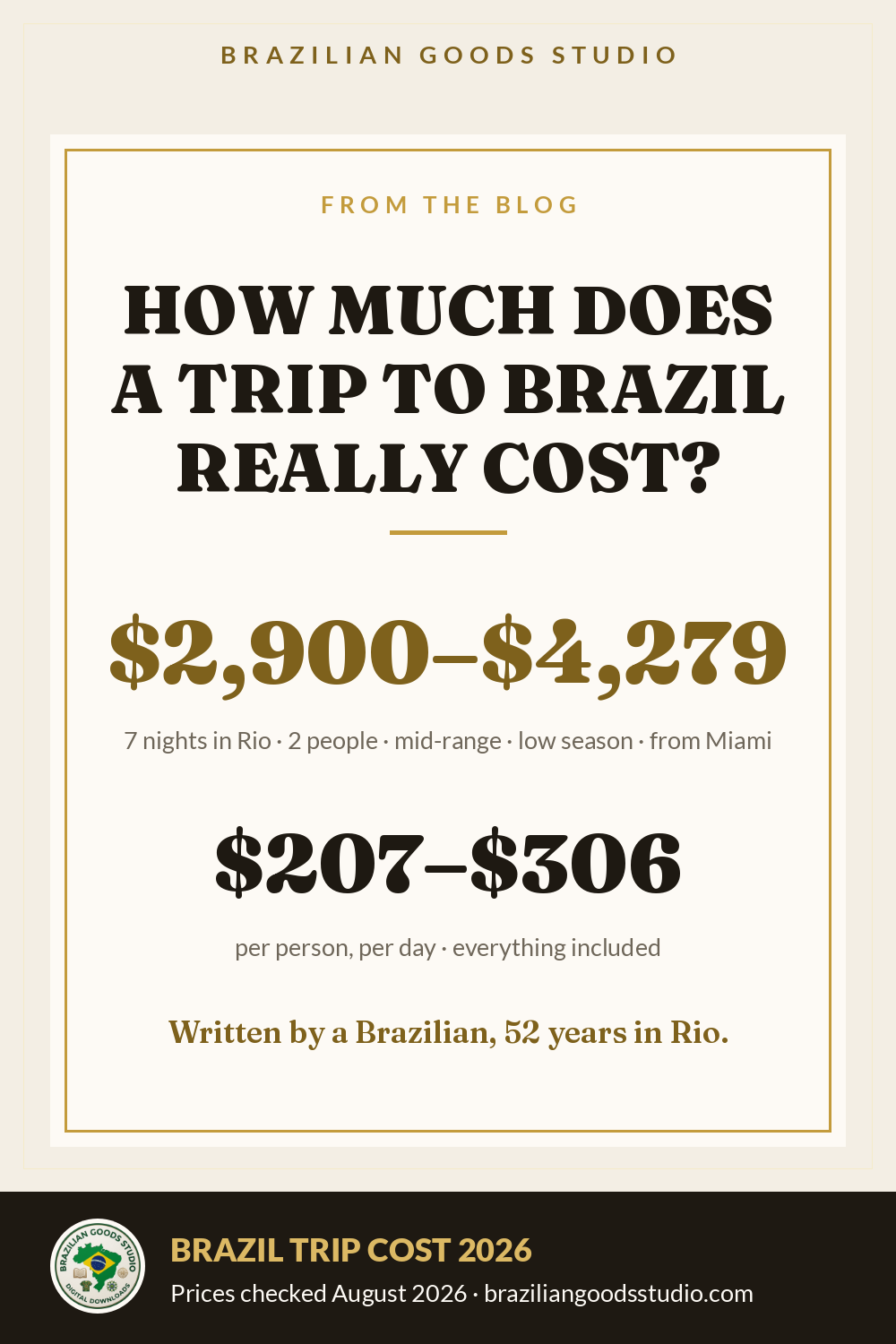
Seven nights in Rio de Janeiro, two travelers sharing a room, mid-range everything, low season, flying out of Miami: $2,900 to $4,279 total. That is $1,450 to $2,140 per person, or $207 to $306 per person per day, and it already includes the round-trip airfare, the room, all your food, your tours, your local transport, your airport transfers, and the e-Visa you cannot skip. Go budget and the same week drops toward $1,900 for two. Go in December instead of October and add roughly $800. Go at Carnival and you are no longer in the same market at all — I will explain why further down.
I was born in Rio and I have lived here for 52 years. I sell real estate here, which means I spend my working life explaining to people what a number actually covers. Most Brazil budgets you find online are written by someone who visited for nine days and converted a few receipts. This one is built from prices I can point at, and from the things you only learn by living somewhere — like the fact that I pay R$89 to ride the Sugarloaf cable car and you will pay R$205 for the exact same car.
The Short Answer, in a Table
These are Rio prices in low season, per person, per day. Lodging is shown per person assuming two people share one room, because that is how the money actually works.
| Per person, per day | Budget | Mid-range | Comfort |
|---|---|---|---|
| Room (half of a double) | $12–23 | $28–45 | $75–140 |
| Food | $15–22 | $28–40 | $70–120 |
| Sights and tours | $8–16 | $22–40 | $60–105 |
| Getting around town | $4–8 | $10–18 | $25–50 |
| Daily total | $39–69 | $88–143 | $230–415 |
Then the one-time costs, also per person:
| One-time | Amount |
|---|---|
| Round-trip flight, Miami → Rio, low season | $656–900 |
| Round-trip flight, New York → Rio, low season | $593–823 |
| Airport transfer, both directions | $10–20 budget · $25–50 mid · $60–100 comfort |
| Brazil e-Visa — required, non-refundable | $80.90 |
| Yellow fever shot in the US — recommended, not required | $220–250 |
One detail that trips people up: seven nights is eight days of eating. You have lunch the day you land and lunch the day you fly home. That is why the Brazil trip cost calculator counts one more day of food and transport than you have nights, and it is why a “seven-night” budget you build on a napkin always comes in low.
The Flight Decides Everything, and the Calendar Decides the Flight
Airfare is the biggest single line and the only one that swings by more than double. Low season here is April through June and August through November. High season is December through March, plus July. Peak is Carnival and New Year’s, and peak is its own animal.
From Miami you are looking at $656–900 in low season, $960–1,420 in high, and $1,300–2,100 at peak. From New York, $593–823 low, $1,071–1,420 high, $1,400–2,300 peak.
Here is the part Americans get backwards. You assume Brazil is expensive in December because it is summer here. That is not the reason. December is expensive because Brazilians are traveling. School lets out, the mandatory thirteenth-month salary lands in workers’ accounts in the first half of the month, and the entire country goes somewhere. You are not competing with other Americans for a seat. You are competing with a nation of 200 million on holiday with a bonus in hand.
Which is exactly why October is the cheapest month to fly here, by every source I can find. Nobody in Brazil is on vacation in October. Spring is well underway, the city is warm, the ocean is honest about being cold in the morning, and the beach on a Tuesday belongs to the neighborhood. If your dates are flexible, moving a December trip to October is the single largest saving available to you — bigger than any hotel choice you will make.
Book six to eight weeks out for low season. For July, Carnival, or New Year’s, book four to ten months out.
Carnival Is Not “High Season.” It’s a Different Market.
This is the thing I most want you to understand, because the calculator’s peak numbers look absurd until you know it.
Carnival 2027 parades run 5–9 February, with the champions’ parade on the 13th. During Carnival and New Year’s in Rio, hotels do not sell you a night. They sell you a package, with a mandatory minimum of three to six nights, paid up front. You cannot arrive on Saturday and leave on Monday. The unit of sale changes.
That is why a mid-range room that costs $55–90 a night in October costs $400–900 a night at Carnival, and a comfort room goes from $150–280 to $900–2,000. It is not a seasonal markup. It is a different product with a different minimum, sold under different rules, and the market clears because the demand is global.
So budget accordingly, or do what a lot of cariocas do and leave town. There is no in-between. If Carnival is the trip you want, run the Brazil trip cost calculator on the Carnival setting before you fall in love with a date — the number is real and it is better to meet it now.
The Gringo Price: Where You Pay More Than I Do
Some Brazilian attractions have tiered pricing by residency. This is legal, it is common, and almost no English-language budget accounts for it, which is how those budgets come out 20–30% light on sightseeing.
Sugarloaf cable car. Foreign visitor: about R$205. A Brazilian from another state: R$160. A carioca like me: R$89. Same cable car, same view, same ride.
Jardim Botânico. Foreign visitor: R$80. Brazilian: R$40. Exactly double. It is still one of the best mornings in this city, and I would pay the R$80 without complaining, but you should know it is coming.
Now the good news, because it goes both ways:
Corcovado train. R$134, same for everyone. Maracanã stadium tour. R$94, same for everyone. Iguaçu National Park, Brazilian side. R$134. Macuco Safari: R$384. Parque das Aves: R$110. Escadaria Selarón, the tiled staircase everyone photographs: free, always, for everybody.
At current rates — R$5.19 to the dollar — R$205 is about $39 and R$134 is about $26. A full sightseeing day in Rio with one big paid attraction, transport, and lunch lands squarely in that $22–40 mid-range tour band.
Eating Well Without Spending Like a Tourist
$28–40 a day for food, mid-range, is not a starvation budget in Rio. It is a comfortable one, if you eat the way we eat.
Three things do the work.
Breakfast is almost always included. Nearly every Brazilian hotel and pousada includes a real breakfast — bread, cheese, ham, eggs, fruit, cake, coffee, juice. That removes one of three meals from your day, worth $6–15 per person daily. Hostels and some of the big Copacabana towers charge for it separately, and a short-term rental apartment never includes it, so check before you book. It is a genuine line item, not a perk.
Lunch is the big meal, and lunch is cheap. The Brazilian working lunch is either a prato feito — a plate of rice, beans, protein, salad, and fries for around R$21 to R$28 — or a comida por quilo buffet where you build a plate and pay by weight, averaging about R$80 a kilo nationally. A serious plate is 400 to 500 grams. Do the arithmetic: that is a full hot meal for $6 to $8. Eat your main meal at 1pm like a local and dinner becomes optional.
Walk one block back from the water. The kiosks on the sand and the restaurants facing Avenida Atlântica are paying beachfront rent and you are paying it with them. One street inland the same beer costs half. A draft beer runs R$12–13 in a normal neighborhood bar, a coffee R$5–8, a caipirinha R$20–40 depending on how much of the view you are buying.
And two rules about paying:
The 10% service charge on your bill is the tip. You do not add anything on top of it. There is no culture of tipping above the 10%, and legally it is optional — you may ask for it to be removed, though most people simply pay it. Beach kiosks and by-the-kilo places usually do not charge it at all.
When the card machine asks whether you want to pay in dollars or reais, always choose reais. That prompt is dynamic currency conversion and it costs you 2–4% over the real rate, going to the payment processor, not to the restaurant. Your own bank’s foreign transaction fee, 0–3%, you pay either way. And no, you do not owe Brazilian IOF tax as a foreign visitor — that applies to Brazilian residents converting money outward, not to your American card spending here.
Getting Around, and the Transfer Nobody Budgets
Local transport is the cheapest line in the whole trip. The Rio metro is R$7.90 a ride. City buses, the BRT, and the light rail are R$5.00. That is a dollar and a half to cross the city.
Rideshare is where it adds up, and both Uber and 99 operate here. As a rule 99 comes in 10–20% under Uber, and I would rather you spend $4 on a car at midnight than save it and walk. Budget $4–8 per person per day if you mostly use the metro, $10–18 if you mix in cars, $25–50 if you take cars everywhere.
The airport transfer is separate and people forget it entirely. Galeão to Copacabana runs R$50–130 by rideshare, or R$18–25 on the air-conditioned airport bus. Round trip, that is $10–20 per person on a budget, $25–50 mid-range, $60–100 if you want a driver with your name on a sign after ten hours in a middle seat. Which, honestly, some days is worth it.
One more: ATM withdrawals here carry a fee of roughly R$20 each and are typically capped around R$1,000, with many machines refusing foreign cards outside 6am to 10pm. Take out fewer, larger amounts, during the day.
The Two Costs Americans Always Miss
The e-Visa is required and it is $80.90 per person. Since April 2025, US citizens need a visa to enter Brazil. It is applied for online, it is valid ten years with multiple entries, and it is non-refundable even if you are denied. It also takes up to ten business days, and the official portal recommends applying two months ahead. Apply on the official government portal only — there is an entire industry of middleman sites charging $120–250 to fill in the same form for you. Budget it for every traveler in your party, children included.
The yellow fever shot is $220–250 in the US, and it is not required. The CDC recommends it for Rio, Iguaçu, Salvador, and Búzios. Brazil does not demand it at the border. It is rarely covered by American insurance, it needs to be taken ten days before travel, and few clinics are certified to give it, so it needs four to eight weeks of lead time. This is a decision, not a fee — talk to your doctor and then decide whether it belongs in your budget. For two travelers it is up to $500, which is real money against a $3,000 trip.
How I Would Actually Budget This
Pick your season first, because the season moves the flight and the flight moves everything. Pick your travel style second. Then treat the visa and the transfers as fixed costs you cannot negotiate, and give yourself the room in food and tours, where a bad day costs you $30 and a good decision saves you the same.
For two people, seven nights, mid-range, low season, out of Miami, the honest window is $2,900 to $4,279, and if you spend the low end of that you will not have suffered for it once. Run your own dates and your own style through the Brazil trip cost calculator — it works on the same numbers you just read, for Rio, Búzios, Iguaçu, and Salvador. And if you want the whole thing laid out on paper before you go, the printable guides and planners are in the shop.
Come in October. Eat lunch at one o’clock. Choose reais. You will do fine.
Prices checked 14 August 2026 · exchange rate R$5.19 to the dollar
The calculator on this site is re-checked and re-sourced every 15 days, so the numbers you run today are the numbers as of this fortnight — not a figure someone typed in three years ago and forgot.
Three small buys that pay for themselves on the ground
Nothing on this list changes the big numbers above. Each one exists because buying it in Brazil, in a hurry, costs several times what it costs at home.
- Brazil plug adapter (Type N) — the plug here is genuinely unusual. Airport and hotel-lobby prices for one are the definition of a captive market.
- Brazilian Portuguese phrasebook — the fastest way to stop being treated as a tourist at the counter. Asking “quanto custa?” in Portuguese changes the answer more often than travellers expect.
- Universal travel adapter with USB-C — if Brazil is one stop on a longer trip, this replaces the drawer of single-country adapters.
As an Amazon Associate I earn from qualifying purchases. We only list books and gear we would hand to a friend, and we never quote a price here — check the current price on Amazon, since it changes.