
On Sunday, 4 October 2026, Brazil votes. That is nine days from today. More than 158 million people are registered, and most of them are not simply invited to show up. They are required to.
A few weeks later, on 3 November, Americans go to the polls for the midterms. Put the two elections side by side and you get one of the best civics lessons you can teach this fall. Not about who should win — we are not going to tell you who to root for, and this post doesn’t name a single candidate. It is about how the machine of a democracy is built, and how two big countries built theirs in opposite ways.
The numbers, for the record. Brazil’s Superior Electoral Court (TSE) counts 158.7 million eligible voters for 2026, spread across 517,206 polling sections, with 918,876 of them voting from abroad. The first round is 4 October; if no presidential candidate gets more than half of the valid votes, a runoff follows on 25 October.
Sixteen may, eighteen must, seventy may again
This is the fact that makes American kids sit up. In Brazil, voting is mandatory from 18 to 70. It is optional at 16 and 17, optional again after 70, and optional for anyone who cannot read. All of that has been in the Constitution since 1988.
So a 16-year-old in Rio can walk into a polling station on 4 October and help choose a president. About 1.6 million teenagers of 16 and 17 are registered to do exactly that this year. Their parents, meanwhile, have no choice in the matter.
What happens if an adult simply stays home? The fine is almost comically small — up to R$ 3.51, well under a dollar. The fine is not the point. The point is what an unpaid one blocks: a passport, a government job, enrollment in a public university. Skip three elections in a row without an excuse and your voter registration is canceled. It is not a sledgehammer. It is a hundred small doors that quietly stay locked.
The result is that roughly four in five registered Brazilians turned out in 2022 — on a Sunday, which is always election day here, so nobody has to choose between voting and a shift at work.
A ballot with no paper and no names
The second surprise is the ballot itself. There isn’t one — not on paper. Brazil began testing electronic voting machines in 1996, and since 2000 every single vote in the country has been cast on one.
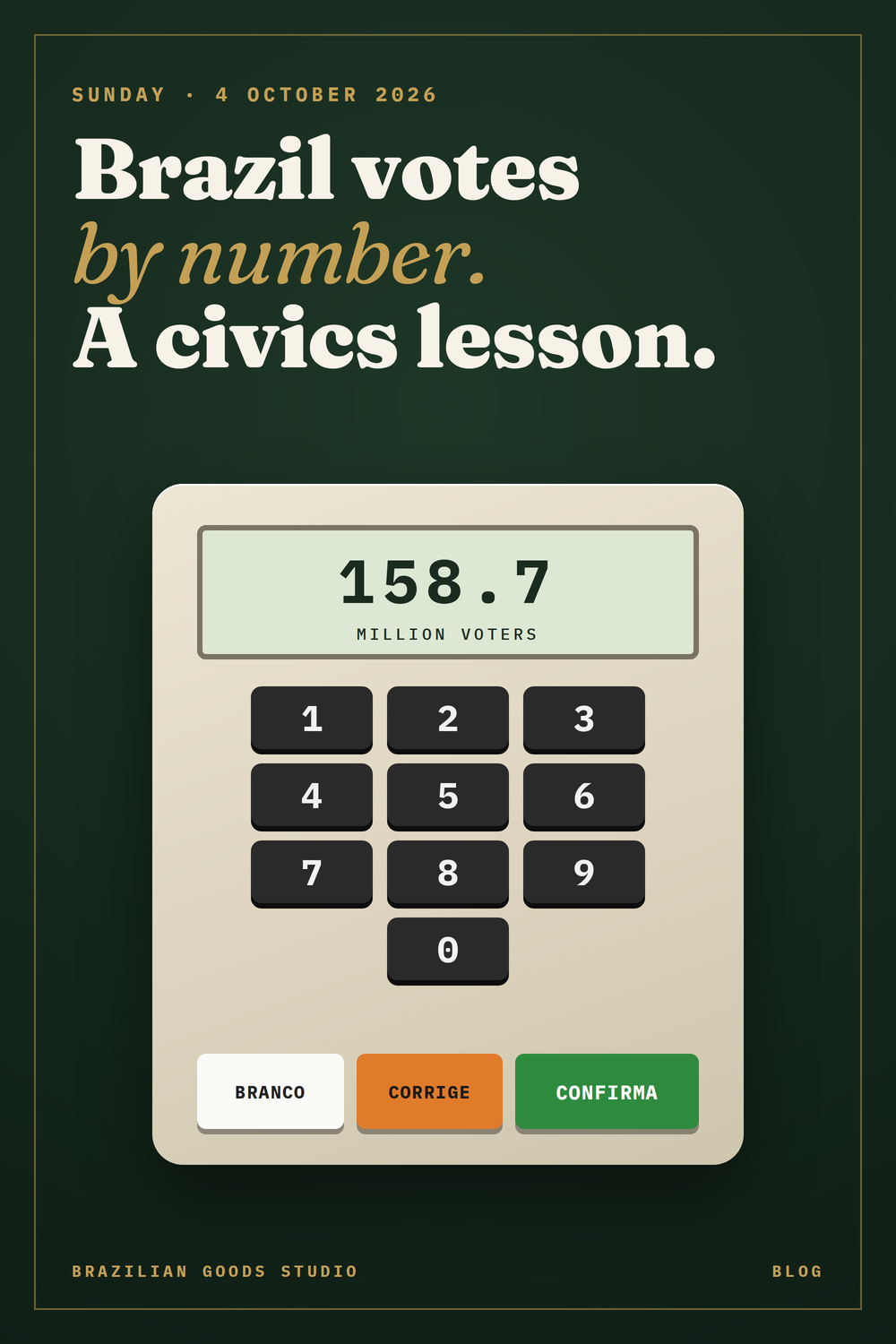
The machine, the urna eletrônica, looks like a small beige box with a screen and a telephone keypad. You don’t pick a name from a list. You type a number. Every candidate has one, the party’s number comes first, and Brazilians walk in with a slip of paper in their pocket listing the numbers they plan to punch. The candidate’s photo appears on the screen, and you press a green key that says CONFIRMA. There is an orange one to correct and a white one to cast a blank vote.
Polls close at 5 pm Brasília time. Each machine then prints a paper tally — the boletim de urna — that anyone can read and compare, and the national result usually arrives a few hours after the polls close. For a country this size, that speed is the thing foreign observers ask about first.
The strangest rule of the week
From 29 September until 48 hours after the vote, Brazilian law says no voter can be arrested, except when caught in the act or under a few narrow exceptions. Candidates got the same protection even earlier, from 19 September. The rule dates from 1965, and the reasoning is blunt: an arrest the week of an election is too easy to turn into a way of keeping someone from the polls.
Ask your children what problem a law like that was written to solve. It is a surprisingly good way into the question of why elections need rules at all.
Three things to do at the kitchen table this week
1. The number ballot. Choose something the family actually has to decide — Friday dinner, the next read-aloud, the weekend hike. Give each option a two-digit number. Draw a phone keypad on paper, add a green CONFIRM square and a white BLANK square, and let everyone vote by “typing” a number. Then ask: what happens if somebody types a number that belongs to nobody? (In Brazil, that vote is void.)
2. The side-by-side chart. Two columns, Brazil and the United States. Rows for: voting age, is it required, what day of the week, paper or machine, and how long the count takes. Let the child fill in the U.S. column by research. The rows where they have to look hardest are the ones they will remember.
3. The debate. Should voting be required? Give one child the “yes” side and one the “no”, and make each argue the side they didn’t pick. Brazilians themselves are split on it, and so are political scientists — which makes it a real question and not a quiz.
The part worth keeping
Every democracy is a set of choices about small things: which day, what age, paper or screen, carrot or stick. Brazil and the United States made nearly opposite choices on almost every one of them, and both still call the result an election. Children who see that early stop thinking of their own country’s rules as the way things simply are — and start asking why.
That question is the whole point of civics.
If you want to take Brazil further than one election week, our Brazil Unit Study builds the country out across geography, history, food and folklore — the kind of context that makes a headline from Brazil make sense.
Sources: Tribunal Superior Eleitoral (TSE), “Faltam 30 dias: Brasil tem mais de 158 milhões de eleitoras e eleitores aptos a votar” (September 2026); Agência Senado, “Faltou à eleição? Saiba como justificar e evitar multas” (31 August 2026); TRE-SP, arrest-protection calendar for the 2026 elections (September 2026); Brazilian Constitution of 1988, art. 14; Electoral Code (Law 4,737/1965), art. 236.