
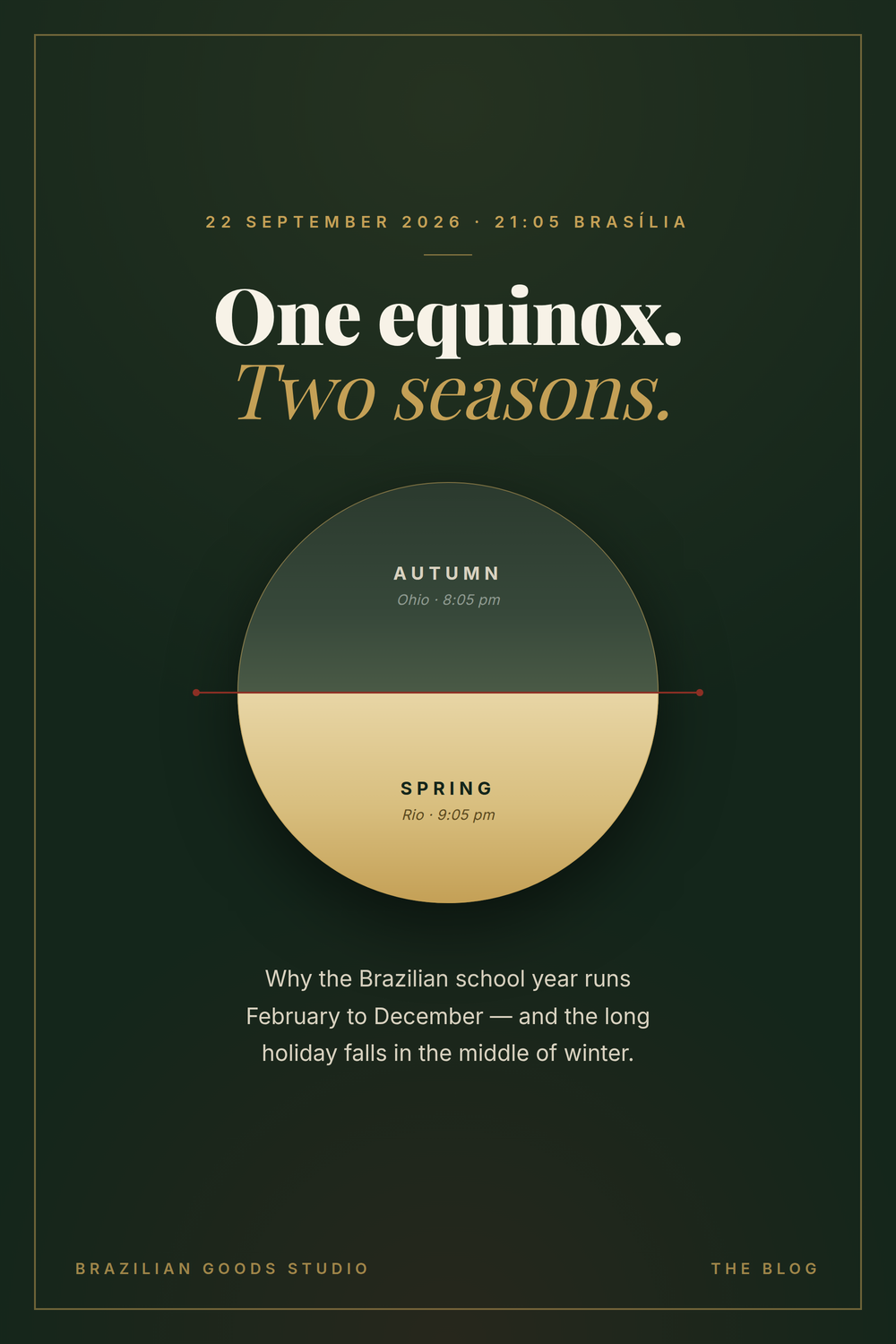
At 00:05 UTC on 23 September 2026 the Sun crosses the celestial equator. In Brazil that same instant is 9:05 pm on 22 September, Brasília time — and in Ohio it is 8:05 pm the same evening. One moment on one clock, and two completely different things happening on either side of a line nobody can see.
North of the equator, autumn begins. South of it, spring. Not a day apart. Not a season apart in some loose, poetic sense. The same second.
The two sources, for the record. Brazil’s Observatório Nacional puts the September 2026 equinox at 22 September, 21:05 Brasília legal time. EarthSky puts it at 00:05 UTC on 23 September. Brasília runs three hours behind UTC, so the two are the same instant, written twice.
Why the seasons flip at all
Ask a child why it is hot in summer and most will tell you the Earth is closer to the Sun. It is the most reasonable wrong answer in science, and the equinox is the cleanest way to dismantle it — because if distance were the cause, both hemispheres would warm and cool together. They do the opposite.
The real cause is that the Earth spins on a tilted axis, about 23.4 degrees off upright, and keeps pointing the same way all year. For half the orbit the northern half leans toward the Sun; for the other half the southern half does. The equinoxes are the two crossing points, when neither leans and the line between day and night runs pole to pole.
Here is the demonstration that ends the argument, and it costs an orange and a flashlight. Push a skewer through the orange, tilt it, and walk it around a lamp on a table without ever changing the direction the skewer points. Stop at four places. Let the child put a finger on the top half and then the bottom half and say which one is getting the light straight on. By the third stop, the explanation is theirs, not yours.
What an upside-down sky does to a school calendar
This is the part that surprises families in the northern hemisphere, and it is the reason we keep coming back to it in our own materials.
The Brazilian school year does not run September to June. It runs from early February to mid-December. Federal law requires at least 200 school days, and once you anchor the start after Carnaval — which floats with the calendar and can land anywhere from early February to early March — the rest of the year falls into place around it.
So:
- The long holiday is in July, in the middle of winter. Not one child here associates the big break with heat, swimming pools or long evenings.
- The school year ends in December, with graduations and final exams landing in the first real week of summer.
- Christmas is a summer holiday. Thirty-plus degrees, the beach packed, and a hot roast on the table anyway, because the recipes came from somewhere colder and nobody has been willing to give them up.
- The new school year starts after Carnaval, which means the single most important date on the Brazilian calendar is also, quietly, the thing that sets when school begins.
None of that is culture inventing itself out of nothing. It is a 23.4-degree tilt working its way all the way down into a report card.
Three things to do at the kitchen table this week
1. The orange and the flashlight. Described above. Ten minutes, and it outlasts a textbook chapter.
2. Write down tomorrow’s sunrise and sunset. Look up the times where you live and subtract. You will land within a few minutes of twelve hours — which is what “equinox” means, from the Latin for equal night. Then look up the same two numbers for Rio de Janeiro or São Paulo and find them nearly identical, on the other side of the planet, in the other season. That coincidence is the whole lesson in two rows of numbers.
3. Put the two school calendars side by side. Draw twelve boxes for the months. Shade your own school year in one colour and the Brazilian one in another. Ask which months are shaded in both, and which in neither. The gaps are the interesting part, and the child will find them faster than you will.
The part worth keeping
Seasons do not change because it got cold. They change because of an angle, held steady while the planet goes around. Twice a year the two hemispheres split the light exactly down the middle, and on that day the difference between north and south is not a matter of weather or temperature or how anybody feels about it. It is geometry, and geometry is teachable.
Tomorrow is one of those two days.
If you want to take Brazil further than a single afternoon, our Brazil Unit Study builds the country out across geography, history, food and folklore, with the calendar quirks included rather than smoothed over.