
Every year between September 15 and October 15, a Brazilian flag sneaks onto somebody’s Hispanic Heritage Month bulletin board. We get it. We are a family in Rio de Janeiro, we live in Latin America, and from far away the whole region can look like one big Spanish-speaking neighborhood.
It is not. Brazil is Latin American, but it is not Hispanic. The reason is a line that two crowns drew down the middle of the Atlantic Ocean in 1494, and it makes for one of the best short history lessons you can teach this month.
The short answer
Hispanic points to Spain and the Spanish language. Latin American points to a place: the parts of the Americas that speak languages descended from Latin, mainly Spanish, Portuguese, and French. Brazil speaks Portuguese, so it belongs to the second group and not to the first.
| Country | Hispanic? | Latin American? |
|---|---|---|
| Mexico | Yes | Yes |
| Spain | Yes | No |
| Brazil | No | Yes |
| Portugal | No | No |
What the U.S. government says
The U.S. Census Bureau uses the federal definition of “Hispanic or Latino,” which covers people of Cuban, Mexican, Puerto Rican, or South or Central American origin, or of other “Spanish culture or origin,” regardless of race. The phrase in quotation marks does the work. Brazil’s language and colonial history trace back to Portugal, not Spain, so the Census Bureau does not count Brazilians in that category. Pew Research Center repeated the point in its yearly explainer, published on September 15, 2026.
One honest footnote: on U.S. forms, “Hispanic” and “Latino” share a single category, and Brazilians fall outside it. In everyday speech, plenty of people call Brazilians Latino simply because Brazil is in Latin America. So “Latino” depends on who you ask. “Hispanic” does not.
The census mix-up that shows the gap
Here is the part your older kids will like. When a Brazilian in the United States checks the “Hispanic, Latino, or Spanish origin” box on a census form and writes in “Brazilian,” the Census Bureau normally recodes the answer as “not Hispanic.” In 2020, a processing error skipped that step for a few groups.
The result, according to Pew Research Center: at least 416,000 Brazilians, more than two-thirds of the Brazilians in the country, showed up as Hispanic or Latino in the 2020 American Community Survey. The year before, the number was 14,000. The year after, it was 16,000.
So the official answer is no. But in 2020, about 70% of Brazilians living in the United States checked the box anyway. That gap between a definition and an identity is a real conversation, and we’ll come back to it in the lesson below.
The line in the ocean
After Columbus came home in 1493, Spain and Portugal, the two great sea powers of the day, argued over who owned lands that nobody in Europe had seen yet. Pope Alexander VI drew a north-to-south line 100 leagues west of the Cape Verde Islands. Portugal pushed back.
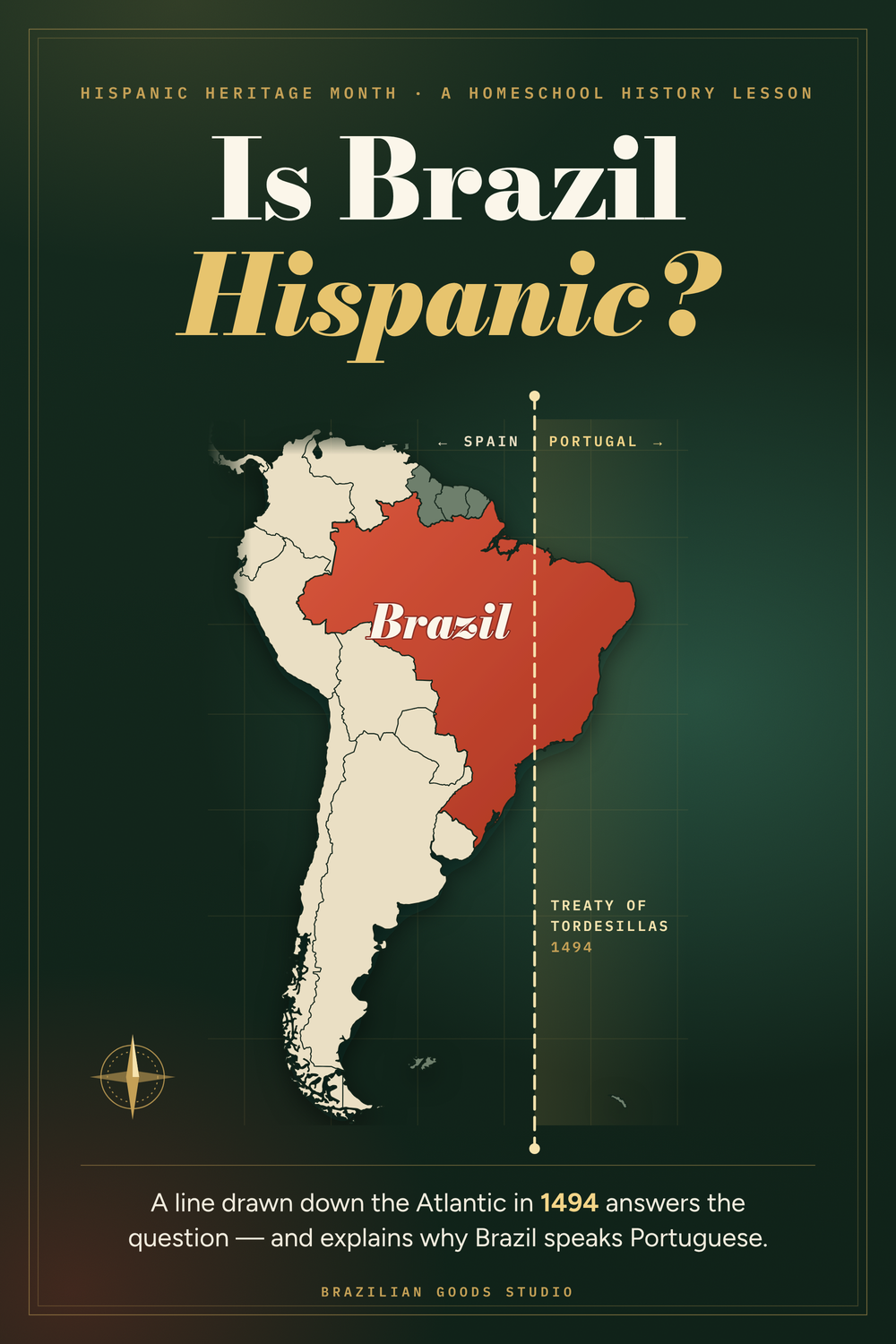
On June 7, 1494, the two crowns signed the Treaty of Tordesillas and moved the line to 370 leagues west of Cape Verde, at roughly 46°30′ W. Everything to the west would be Spain’s. Everything to the east would be Portugal’s.
Nobody at the table knew that South America bulges east across that line. In April 1500, a Portuguese fleet under Pedro Álvares Cabral landed on the bulge. Portugal claimed the coast, and over the next two and a half centuries Portuguese settlers pushed far west of the line. That is why Brazil today covers nearly half of South America, even though the treaty handed Portugal only the eastern tip. Look at the map below: the line runs straight through Brazil.
The calendar tells the same story
Hispanic Heritage Month began as a week in 1968, under President Lyndon B. Johnson, and grew into a month in 1988, under President Ronald Reagan. It opens September 15 on purpose. That date is the anniversary of independence for Costa Rica, El Salvador, Guatemala, Honduras, and Nicaragua. Mexico follows on September 16 and Chile on September 18.
Brazil’s Independence Day is September 7, eight days before the month begins. And in 1822 Brazil declared independence from Portugal, not from Spain.
Teach it in 20 minutes
- Draw the line. Print a blank map of South America. Find 46°30′ W and draw a line from top to bottom. Ask: Who got more land, Spain or Portugal? Then color in Brazil and ask what happened.
- Hear the difference. Say “thank you” in Spanish (gracias) and in Portuguese (obrigado; a woman says obrigada). Try “good morning” (buenos días and bom dia), “window” (ventana and janela), and “dog” (perro and cachorro). Close cousins, not the same language.
- Sort the flags. Use Mexico, Spain, Brazil, Portugal, Argentina, and Haiti. Sort them into four piles: Hispanic only, Latin American only, both, or neither.
- Ask the big question. For older kids: In 2020, most Brazilians in the United States checked a box that the government says does not apply to them. Who decides what you are called, you or the form?
So does Brazil belong on your bulletin board?
Not this month. But a country of more than 214 million people, the largest in Latin America and the only one in the Americas that speaks Portuguese, has earned a week of its own on your calendar.
If you want that week planned for you, our Brazil Unit Study covers the geography, history, food, and wildlife in open-and-go lessons. For two more free lessons, read why the Brazilian school year runs February to December and why a 16-year-old may vote in Brazil and a 30-year-old must.
Sources
- U.S. Census Bureau, About the Hispanic Population and Its Origin and Hispanic Heritage Month: Facts for Features
- Pew Research Center, Who is Hispanic? (September 15, 2026) and How a coding error provided a rare glimpse into Latino identity among Brazilians in the U.S. (April 19, 2023)
- U.S. National Archives, National Hispanic Heritage Month
- Encyclopaedia Britannica, Treaty of Tordesillas, and World History Encyclopedia, Treaty of Tordesillas
- IBGE, Brazil’s estimated population reaches 214.2 million in 2026 (August 28, 2026, in Portuguese)