
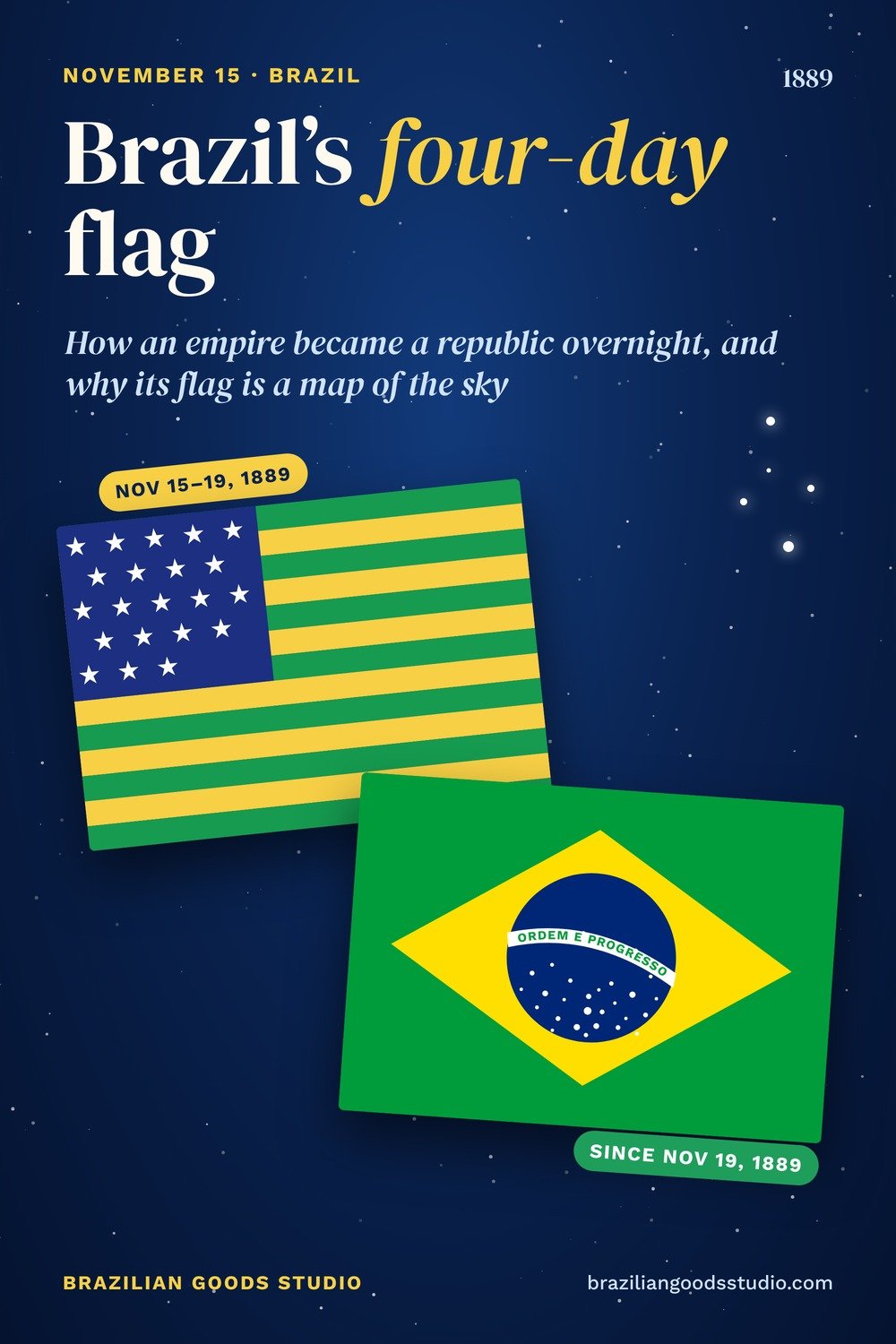
For four days in November 1889, Brazil flew a flag that looked a lot like yours.
Stripes. A blue corner full of stars. Only the stripes were green and yellow, and the country that raised it had been an empire just the week before.
This Sunday, November 15, Brazil marks Proclamation of the Republic Day (Proclamação da República), a national holiday. Here is the story behind it, told the way we tell it at our own kitchen table in Rio, plus a few homeschool ideas to bring it home.
Wait, Brazil had an emperor?
Yes, two of them. When Brazil declared independence from Portugal in 1822, it did not become a republic like the United States. It became the Empire of Brazil, and a Portuguese prince became its first emperor, Pedro I.
His son, Pedro II, became emperor at the age of five and reigned for 58 years. He was a quiet, bookish man who loved science, spoke several languages and corresponded with scholars around the world. The empire lasted 67 years.
November 15, 1889: a revolution with no battle
By the late 1880s, the empire had lost its friends. The army felt ignored, big landowners were furious after slavery was abolished in 1888, and a growing republican movement wanted Brazil to look more like its neighbors.
On the morning of November 15, 1889, in Rio de Janeiro (then the capital), army troops led by Marshal Deodoro da Fonseca brought down the emperor’s government. Here is the twist your kids will love: Deodoro was a personal friend of Pedro II, and the emperor was not even in the city. He was up in the mountains, in Petrópolis.
There was no siege and no last stand. Pedro II chose not to call loyal troops, to avoid a civil war. Before dawn on November 17, the royal family boarded a ship into exile in Europe. Pedro II died in Paris two years later.
Historians still argue about what to call it. In Portuguese textbooks it is a “proclamation”; many historians call it what it technically was, a military coup. Most Brazilians at the time found out after the fact.
The four-day flag
A new country needs a new flag, and fast. From November 15 to 19, the provisional republic used a flag inspired by the United States: horizontal green and yellow stripes with a blue canton of stars.
It did not last. On November 19, 1889, Decree No. 4 created the flag Brazil still uses today: the green field, the yellow diamond and the blue globe with the motto Ordem e Progresso (“Order and Progress”), borrowed from the French philosopher Auguste Comte. That is why November 19 is Flag Day in Brazil, the one day of the year the flag is raised at noon instead of 8 a.m.
The flag is a sky map
This is our favorite part, and it turns into a great astronomy lesson.
The stars on the Brazilian flag are not decoration. They show the sky over Rio de Janeiro at 8:30 a.m. on November 15, 1889, the morning the republic was proclaimed, including the Southern Cross. Each star stands for a state, so new stars were added as Brazil grew. Today there are 27: 26 states plus the Federal District, where Brasília is.
| U.S. flag | Brazilian flag | |
|---|---|---|
| Stars | 50 | 27 |
| What a star means | One state | One state (plus the Federal District) |
| How the stars are arranged | Neat rows | A real sky, as seen from Rio in 1889 |
| Motto on the flag | None | “Ordem e Progresso” |
| Flag Day | June 14 | November 19 |
Brazil got to vote on the king, too
Here is a fact most Americans (and plenty of Brazilians) have never heard. Brazil’s 1988 constitution promised the people a vote on how the country should be governed. On April 21, 1993, Brazilians went to the polls in a nationwide plebiscite and were asked, among other things: republic or monarchy?
The republic won with 66.3% of the vote. The monarchy got 10.3%, and the rest were blank or void ballots, according to Brazil’s electoral court. So the republic that started without a vote in 1889 was finally confirmed by one, 104 years later.
How Brazilians spend November 15
Honestly? Mostly at the beach or at a family barbecue. There are official ceremonies and military parades in some cities, but for most families it is simply a day off. When the 15th falls on a Tuesday or Thursday, Brazilians famously emendam o feriado, skipping the workday in between and turning it into a four-day weekend. This year it lands on a Sunday, so no bridge.
A bonus fact for sports fans: Rio’s Flamengo, the most popular soccer club in Brazil, was founded on November 15, 1895, chosen on purpose so its birthday would always fall on a holiday.
4 homeschool activities for Republic Day
- Design the four-day flag. Have kids draw the U.S. flag, then redraw it in green and yellow. Ask: why would a brand-new country copy someone else’s flag, and why change it four days later?
- Find the Southern Cross. Use a free planetarium app, set the location to Rio de Janeiro and the date to November 15, 1889, 8:30 a.m., and compare the sky with the Brazilian flag. Can you spot the Southern Cross? (It never rises over most of the United States.)
- Hold your own plebiscite. Republic or monarchy for your family? Let each child argue one side for two minutes, then vote with a secret paper ballot. Count the votes together and talk about blank and void ballots.
- Timeline race. Put 1776, 1789, 1822, 1865, 1888, 1889 and 1993 on cards. Kids match each year to an event in the U.S. or Brazil. (Spoiler: Brazil abolished slavery only a year and a half before becoming a republic.)
Take Brazil further
If your family wants more than one afternoon, our Brazil Unit Study covers Brazil’s geography, history, food and folklore, made by our family here in Rio and ready to print at home.
And if your kids want to know how Brazilians vote today, and why a 16-year-old can vote here, start with our civics lesson on the Brazilian election.
Feliz Dia da República! 🇧🇷
— The Brazilian Goods Studio family, Rio de Janeiro
Sources: Brazil’s Superior Electoral Court (TSE) for the 1993 plebiscite results; Decree No. 4 of November 19, 1889, for the national flag; Legislative Assembly of São Paulo for the royal family’s departure on November 17, 1889.