
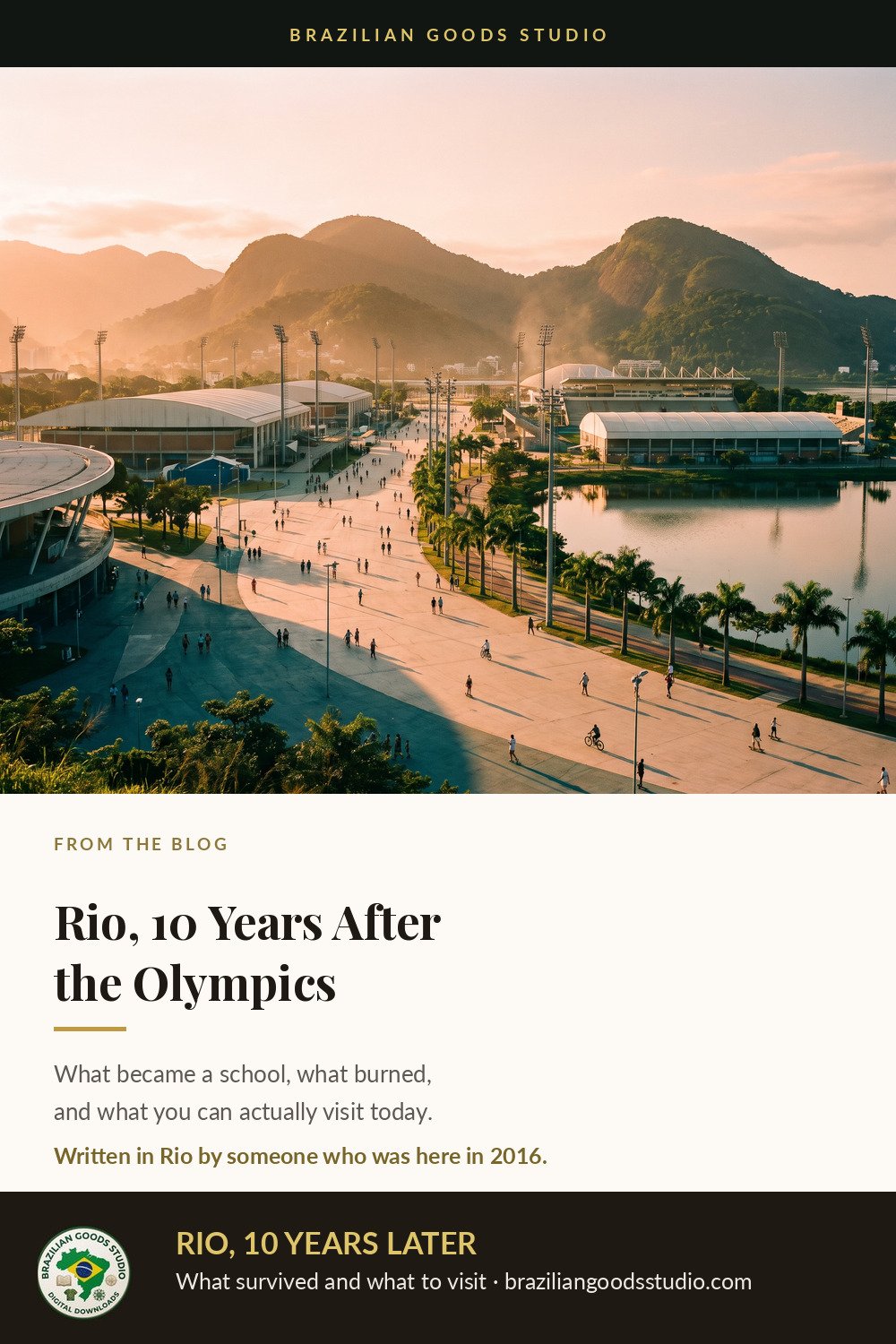
Ten years after the Rio 2016 Games, the Olympic Park is neither the ruin you have seen in “abandoned Olympic venues” videos nor the success story the city puts in press releases. It is a working public sports campus with a burned roof under repair, three arenas now run by the company behind Rock in Rio, and four arenas that were taken apart and rebuilt as public schools in the poorest parts of the city.
If you are coming to Rio in 2026, three of those places are worth a detour. The rest of this post tells you which ones, and why the honest version is more interesting than either headline.
Why this matters in August 2026
The Games ran from 5 to 21 August 2016 — the first Olympics ever held in South America. That makes this month the ten-year mark, and the internet has picked a side. Half of it is running the “2026 is the new 2016” nostalgia wave. The other half is recycling drone footage of empty stadiums shot in 2017 and captioning it 2026.
Both are lazy. Here is what a decade actually produced, with the numbers and the dates.
What worked: the arenas that became schools
The most useful thing Rio did with its Olympic venues was take three of them apart and rebuild them as public schools. This was designed in from the start — the “nomadic architecture” concept — and, unusually for an Olympic promise, it was actually delivered.
- Carioca Arena 3 became the Isabel Salgado Olympic Educational Gymnasium, the first Olympic arena in the world converted into a public school. It serves roughly 1,000 full-time students and offers 26 sports.
- The Future Arena (handball) was dismantled and rebuilt as four educational gymnasiums in Bangu, Campo Grande, Rio das Pedras and Santa Cruz — neighbourhoods far from the Olympic postcard — serving about 1,700 students.
- The Olympic Aquatics Stadium pool was relocated to a public park in the Inhoaíba area, where it now hosts about 2,000 visits a month of free public swimming.
Across the city, Rio now runs 12 of these educational gymnasiums with roughly 5,494 students. Since 2021 the Olympic Park itself has hosted 179 sporting events, national to world level.
That is a real answer to the white-elephant question, and it is the part almost nobody outside Brazil reports.
What worked: the tram nobody talks about
The most-used piece of Olympic legacy in Rio is not a stadium — it is a tram. The VLT Carioca opened in 2016 to move crowds around downtown and the port, and in June 2026 it turned ten with more than 180 million passengers carried and about 95,000 riders a day across 4 lines, 32 trams and 30 stops.
It runs without overhead wires, on 100% renewable energy — Rio was the second city in the world after Dubai to use the technology. If you land in Rio and spend a morning downtown, you will almost certainly ride it without realising you are riding the Olympics.
The same investment cycle gave the port district the Museum of Tomorrow, open since 17 December 2015, which has passed six million visitors and anchored the whole waterfront redevelopment. A 2024 FGV study put the Games’ total impact on the city’s GDP at R$ 51.2 billion, and the city counts 30 legacy projects delivered against 17 originally planned.
What did not work: the bill, and who paid it
The Games cost about US$ 13.1 billion, roughly US$ 3.5 billion over budget — and the overrun is the least uncomfortable number in the story.
Around 600 families had their homes demolished in Vila Autódromo, the community that sat where the Olympic Park now stands. A handful of residents fought and stayed; most did not. Rio’s Olympic construction contracts also sat at the centre of Brazil’s biggest corruption investigation of the decade.
You do not have to take a political position on any of that to notice the pattern: the venues that were designed to become something else worked, and the venues built as monuments mostly did not. The Maracanã — not an Olympic build, but the stadium everyone associates with 2016 — was put up for sale by the state in October 2025. The Olympic Tennis Centre sat idle for close to a decade before reopening for public use this year.
What burned
On 8 April 2026, a fire started in a second-floor room of the Olympic Museum and spread to the velodrome roof. Around 80 firefighters and 20 trucks responded to a call at 4:17 a.m. Nobody was hurt, and the track and the museum collection came through it.
It was the venue’s third fire — the first two were caused by fire balloons landing on the roof. On 28 April 2026 the city started a six-month, R$ 10.7 million roof rebuild, adding a metal mesh and rock-wool insulation under 11,000 m² of structure. Six months from late April lands around the end of October.
This is where every other article stops, so here is the part you actually need: the Rio Olympic Museum is still closed. It is shut for the rebuild, with no reopening date announced. The velodrome’s public sports programme was moved into ground-floor rooms and other arenas in the park and kept running, but the museum itself has not reopened since the fire.
Do not book it from the website. The museum’s own page still lists normal hours and still sells tickets online, which is exactly the trap: you can pay for a visit you cannot make. Nothing in English says so anywhere. If you want to try, ask at the Olympic Park gate on the day, and plan the afternoon as though the answer will be no.
The plot twist: Rock in Rio now runs part of the Olympic Park
Rock World — the company behind Rock in Rio — won the concession to manage three Olympic Park venues: Carioca Arena 1, the velodrome and the Olympic Tennis Centre, for a fixed R$ 19.5 million.
Which means that when Rock in Rio runs on 4–7 and 11–13 September 2026, the Cidade do Rock is not near the Olympic legacy. It is the Olympic legacy, under new management. Foo Fighters open it; Elton John shares 7 September with Gilberto Gil; Twenty One Pilots and Ivete Sangalo close it on the 13th.
If you were already thinking about Rio in September, that is your answer: the Olympic Park will be the busiest it has been since 2016, and the same ground gives you the festival and the history in one trip.
What is actually worth visiting
Three stops, in the order I would do them.
1. Museum of Tomorrow and the port waterfront
Calatrava’s building, ten years old, six million visitors in, and the single best illustration of what the pre-Olympic investment did to downtown. Get there on the VLT — the ride is part of the exhibit. With the Olympic Museum closed, this is the one indoor stop of the three that is certain to be open.
2. The Olympic Park itself, in Barra da Tijuca
The park is open even though the museum inside it is not. On a weekday you will find school groups, national-level training and people using the arenas — which is the whole argument of this post, standing up in front of you. Walk the concourse, look at the velodrome roof under repair, and see Carioca Arena 3, the one that became a school. It costs nothing and takes an hour.
If you are here for Rock in Rio in September, you are going to this address anyway. Arrive early and walk the park in daylight before the gates open.
3. Vila Autódromo
A short walk from the Olympic Park, what is left of the community keeps a small museum of the evictions, run by the residents who stayed. Twenty minutes there will tell you more about what a mega-event does to a city than any stadium tour. Go respectfully — people live there.
What to skip: the “abandoned Olympic venues” tour some operators still sell. The footage those are based on is from 2017.
Frequently asked questions
Is the Rio Olympic Park abandoned in 2026?
No. It is an operating public sports campus hosting national and international competition, with arenas converted into schools and three venues under private management by Rock World. The velodrome roof is under repair after an April 2026 fire, and the Olympic Museum inside it is closed, but the park itself is open.
Can you visit the Rio Olympic Park?
Yes, the park is open to the public in Barra da Tijuca and costs nothing to walk. The Rio Olympic Museum inside the velodrome is a different matter — see below.
Is the Rio Olympic Museum open?
No. As of August 2026 the Rio Olympic Museum is closed for the velodrome rebuild, with no reopening date announced. It opened on 3 August 2025 and closed after the fire of 8 April 2026, which started in a second-floor room of the museum itself. Its website still advertises normal hours and still sells tickets, so do not book online — ask at the Olympic Park on the day.
What happened to the Rio 2016 venues?
Carioca Arena 3 became a public school; the Future Arena was dismantled into four schools in outer neighbourhoods; the Aquatics Stadium pool was relocated to a public park; Carioca Arena 1, the velodrome and the Tennis Centre are run by Rock World; Carioca Arena 2 is becoming a federal institute.
Did the Rio Olympics leave anything useful?
The clearest legacies are transport and education: the VLT tram, with 180 million passengers in ten years, the BRT corridors, the port redevelopment anchored by the Museum of Tomorrow, and 12 educational gymnasiums serving around 5,494 students.
How much did the Rio Olympics cost?
About US$ 13.1 billion, roughly US$ 3.5 billion over budget, with around 600 families displaced from Vila Autódromo.
When is Rock in Rio 2026?
4–7 and 11–13 September 2026, at the Cidade do Rock inside the Olympic Park in Barra da Tijuca.
Planning a Rio trip around this
If you are building an actual itinerary, the Olympic Park is a half-day and it is far from Copacabana — Barra da Tijuca is its own city, and the BRT is how you get there without paying for a long taxi ride.
Our Rio de Janeiro Travel Guide covers the neighbourhood-by-neighbourhood logistics that this kind of day trip lives or dies on, and the Brazil Travel Guide goes wider if Rio is one stop of several.
One thing worth doing before anything else: Americans have needed an e-Visa for Brazil since 10 April 2025. It costs US$ 80.90, it is valid for ten years with multiple entries, and airlines check it before they issue your boarding pass at the departure airport. Apply well ahead of a September trip.
Written in Rio de Janeiro by Luciano Moreira, who was born here and has worked in Rio real estate through the whole decade this post covers. Figures verified against the City of Rio, the IOC, Alstom and Brazilian press in August 2026. Venue status changes — confirm before you travel.
Updated 23 August 2026: the Rio Olympic Museum is confirmed closed for the velodrome rebuild, with no reopening date. Its own website still shows normal opening hours and still sells tickets. Verified locally, not from the site.
If You Are Going to Walk the City Yourself
This piece is about what you can actually visit. If you plan to do it on foot rather than from a tour bus window, four things earn their space.
- Lonely Planet Rio de Janeiro — The current edition, with the neighbourhoods that changed after 2016 rewritten.
- Baggallini Securtex anti-theft sling — Locking zips and a cut-resistant body. It looks like a normal bag, which is the point.
- Alpha Keeper RFID money belt — Card and passport go under the clothes; the sling carries what you do not mind losing.
- Lonely Planet Portuguese Phrasebook — Outside the tourist strip, English runs out fast.
Rio rewards people who walk it. It rewards people who walk it prepared rather more.
Brazilian Goods Studio is a participant in the Amazon Services LLC Associates Program. As an Amazon Associate we earn from qualifying purchases, at no extra cost to you. Check current price on Amazon.