

Exchange-rate note, updated 2 September 2026. The dollar has weakened against the real this year. It opened 2026 at R$ 5.52 and traded at about R$ 5.10 on 2 September — roughly 7% less buying power than in January. The prices in this article were converted at the rate noted below, so treat the dollar figures as a floor: the real cost today is a little higher. The prices in reais have not changed.
The 2027 FIFA Women’s World Cup runs from 24 June to 25 July 2027, across eight Brazilian host cities, with the final at the Maracanã in Rio de Janeiro. As of today, tickets are not on sale. What is open is a free registration of interest on FIFA’s site, and the first real sales phase is expected around September or October 2026. So the two things worth doing this week are registering, and starting your Brazilian e-Visa — because Americans have needed one since 2025 and it is the step people leave until it is too late.
I was born in Rio and I have lived here for 52 years. I have watched this city host a World Cup, an Olympics and thirty-odd Carnivals, and the pattern is always the same: the people who have a good time are the ones who booked before the schedule came out, and the people who overpay are the ones who waited for certainty. Certainty arrives about four months before kick-off, and by then the good rooms are gone.
This is the planning piece I would want if I were flying in from the United States. No hype, no “top 10 things”, just the eight cities, what the weather actually does in June and July, what a trip costs, and what to do in what order.
The eight host cities, and what each one actually is
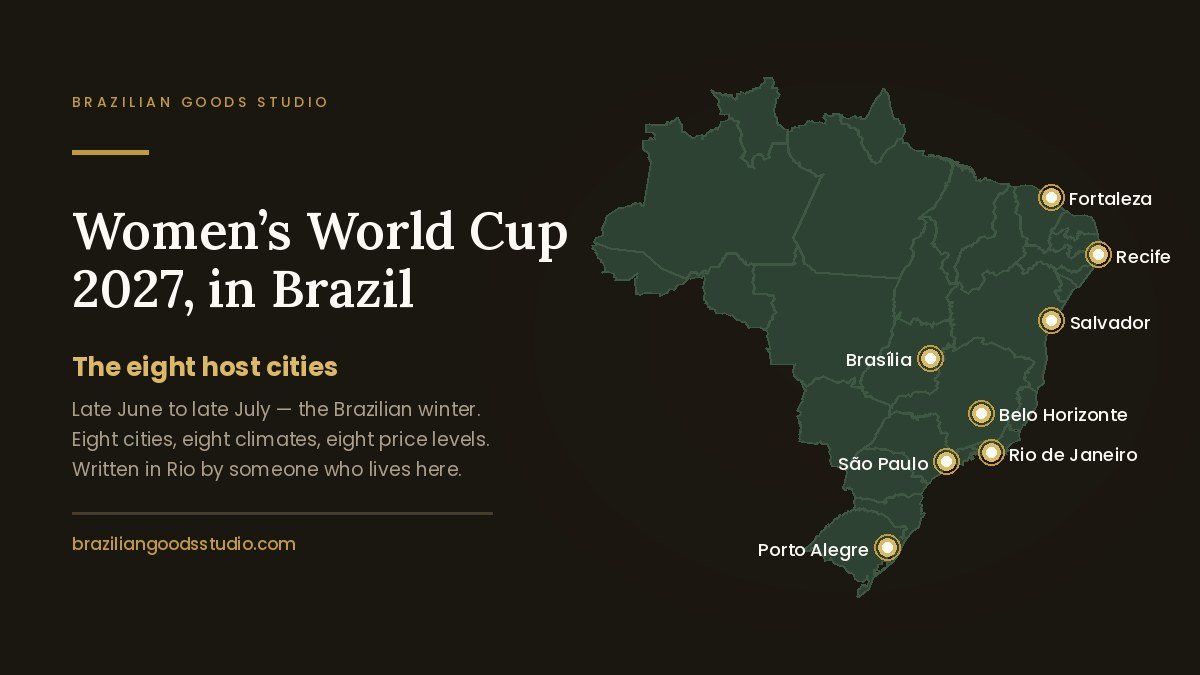
FIFA confirmed eight host cities. They are spread across a country larger than the contiguous United States, and they do not share a climate, a food culture or a price level. Choosing between them is the single biggest decision in this trip.
| City | Stadium | Region | Late June to July, honestly |
|---|---|---|---|
| Rio de Janeiro | Estádio do Maracanã | Southeast, coast | Dry winter. The clearest, most comfortable time of the year here — and yes, people swim. |
| São Paulo | Arena Itaquera | Southeast, inland | Cool, grey, drizzly. The best food in the country and no beach at all. |
| Belo Horizonte | Estádio Mineirão | Southeast, highlands | Dry and mild. The cheapest of the eight, and Inhotim is ninety minutes away. |
| Brasília | Estádio Nacional | Central plateau | Peak dry season. Warm days, cold nights, very low humidity. |
| Salvador | Arena Fonte Nova | Northeast, coast | Warm, with showers. The strongest Afro-Brazilian culture of the eight. |
| Recife | Arena de Pernambuco | Northeast, coast | ⚠️ Its two wettest months of the year. See below. |
| Fortaleza | Arena Castelão | Northeast, coast | Warm all year, but this is the tail of the rainy season. |
| Porto Alegre | Estádio Beira-Rio | Deep south | Genuinely cold. Bring a proper coat. Not a joke. |
Nobody tells Americans this: it is winter, and it is the good kind
June and July are the middle of the Brazilian winter. Americans hear “winter” and picture a ruined beach holiday. In Rio it is the opposite: winter is the dry season, the humidity drops, the sky clears, and it is the stretch of the year when locals actually go up Corcovado, because in February you pay to stand inside a cloud.
But the same month behaves completely differently 2,000 kilometres up the coast. Recife’s two rainiest months of the entire year are June, with about 380 mm, and July, with about 390 mm. That is not a shower — that is the wettest point of Recife’s calendar landing exactly on the tournament. If your team draws Recife, plan for rain and plan indoor days. Fortaleza sits at the tail of the same wet season.
Porto Alegre is the mirror image. It is the southernmost host city, it is winter, and it gets cold in a way that surprises people who packed for “Brazil”.
We built a free Best Time to Go tool that breaks four Brazilian destinations down month by month, and a longer piece on the best time to visit Brazil that explains why the answer is different for every region. Both are worth ten minutes before you book anything.
Tickets: what is true today, and what is not
- Tickets are not on sale. Anyone selling you a 2027 Women’s World Cup ticket right now is not selling you a ticket.
- Registration of interest is open through FIFA’s official channels, and it is free. It needs a FIFA account. Registering does not give you a queue position or a guarantee — it puts you on the list to be told when sales open.
- The first sales phase is expected around September or October 2026, based on how FIFA has run recent tournaments. FIFA has not confirmed a date.
- Prices have not been published. Any figure you see quoted today is a guess.
- The match schedule was still not out as this was written, which means nobody knows yet which city hosts which group.
The date that will move the market: 27 November 2026
The United States has not qualified yet. The USWNT plays El Salvador in the Concacaf quarter-finals on 27 November 2026. They are heavy favourites — but until that match is played, American demand for Brazilian hotels in June 2027 is soft. The night they qualify, it will not be.
If you are the kind of traveller who books refundable and decides later, the window between now and late November is the cheapest air and hotel you will see for this tournament.
The visa is the step people get wrong
Brazil reinstated the visa requirement for US, Canadian and Australian citizens on 10 April 2025, and switched to a new e-Visa system in February 2026. The fee is US$80.90 per person, children included, and it is not refundable. For US citizens it is valid for ten years with multiple entries, so one application covers this trip and the next one.
Processing is usually 48 to 72 hours, but the official window is up to ten business days, and it will not be 48 hours in the weeks before a World Cup. Apply the moment you have a ticket. Apply only through the official government site — the search results are full of agencies charging three times the fee to fill in the same form.
What it actually costs
These are real outputs from our own Brazil trip cost calculator, run on the day this was published: 10 nights, two travellers, mid-range style, high season, flying from Miami, including international airfare, the e-Visa, insurance and an eSIM.
| Host city | 10 nights, two people, all in |
|---|---|
| Belo Horizonte | $3,551 – $5,318 |
| Salvador | $3,917 – $6,398 |
| São Paulo | $4,119 – $6,254 |
| Rio de Janeiro | $4,614 – $7,298 |
| Rio + Salvador, 12 nights (8 and 4, one domestic flight) | $5,173 – $8,198 |
Style moves the number more than the city does. The same ten nights in Rio come to $3,228 – $4,978 on a budget and $8,652 – $14,558 in comfort. If you are trying to make this trip happen, the lever is how you sleep and eat, not which host city you fly into.
Two things those numbers do not include, and I would rather say so than have you find out later.
- Match tickets. No price exists yet.
- The tournament premium. The figures above are ordinary high season. A World Cup does to a host city what Carnival does to Rio, and we have the number for that: Carnival 2026 pushed the Rio hotel market to an average daily rate of R$1,312, up 49.4% in a single year, peaking at R$2,657 with 93.7% occupancy. Salvador runs above 95% occupancy at Carnival and sells rooms in blocks. For match nights in a host city, read the calculator’s Carnival column, not the High one.
One piece of good news on money: the dollar buys R$5.21 today, and the real has strengthened about 4% against it over the last twelve months. Brazil is still cheap for an American — just less cheap than the blog posts from 2024 say it is.
If you only have ten days, which city do you pick?
This part is opinion, and it is the opinion of somebody who lives here rather than somebody who read a press release.
- Rio. Base here. It is the one city where the tournament window is also the best weather of the year, the final is at the Maracanã, and everything else in the southeast is a short flight away. It is not the cheapest and it does not need to be.
- Salvador. The best second city, and the one that will change how you think about Brazil. Direct flight from Rio, two hours.
- Belo Horizonte. Quietly the smart pick if money is tight. Cheapest of the eight, dry in June, and Inhotim — which the New York Times put on its 52 Places to Go in 2026 — is ninety minutes down the road.
- São Paulo. Go for the food. Do not go for the scenery. Best domestic flight connections in the country.
- Recife or Fortaleza. Only if your team is playing there. Beautiful coast, wrong month.
- Porto Alegre. Same rule, plus a coat.
- Brasília. One of the strangest cities on earth architecturally, and worth two days if you like that sort of thing. Not worth ten.
The pairing I would actually book: Rio for the football, Salvador for the four days after it. That is the combination in the cost table above, and it is the one I would send my own family on.
The order to do things in
| When | What |
|---|---|
| Now | Register your interest with FIFA. Start the e-Visa. Price refundable hotels in Rio for late June 2027 and screenshot what you see — that is your baseline. |
| Sept–Oct 2026 | Expected first ticket sales phase. Be registered before it opens, not during. |
| 27 Nov 2026 | USWNT qualifier. Book flights and refundable rooms before this, not after. |
| After the draw | Now you know your cities. Convert refundable bookings into the right ones and add the domestic flights. |
| Jan–Mar 2027 | Domestic flights inside Brazil. Remember a checked bag is not included in a Brazilian domestic fare and is charged per leg. |
| 60 days out | Confirm the e-Visa is in hand, buy insurance, sort the eSIM. |
Where this leaves you
A ten-day trip to the 2027 Women’s World Cup, for two people, mid-range, from the US, lands somewhere between $4,600 and $7,300 before match tickets — and it will be higher than that in a host city on a match night. That is a real number, not a brochure number, and you can move it yourself.
Run your own dates through the trip cost calculator — it now covers eight destinations and prices the domestic flight between two of them. Check your month against the Best Time to Go tool. And if you want the whole thing written down by somebody who lives here, the Brazil Travel Guide Bundle is $16.99 and covers Brazil, Rio and Búzios in one download.
See you at the Maracanã.
Sources
Host cities and stadiums: FIFA. Dates, final venue and ticket status: The World Cup Guide, updated 27 July 2026. USWNT qualifying date: Goal. Recife rainfall: Climates to Travel. Rio Carnival hotel rates: TravelDailyNews, 17 March 2026. Exchange rate: Trading Economics. Inhotim on the 2026 list: New York Times 52 Places to Go. Trip costs: our own price base, last checked 17 August 2026.
What to Pack for a World Cup Summer in Brazil
Stadium days in Brazil run long and hot, and the small stuff is what ruins them. Five things worth putting in the bag before you worry about anything else.
- Ceptics Brazil (Type N) plug adapter — Brazil uses its own socket. Nothing you own fits it without this.
- Anker Nano 45W power bank — Your phone is your ticket, your map and your translator. It will not last the day alone.
- Alpha Keeper RFID money belt — Worn under the shirt, it is the difference between a bad afternoon and a ruined trip.
- Blue Lizard Sensitive Mineral SPF 50 — A Brazilian summer afternoon in an open stand is not the sun you are used to.
- Lonely Planet Portuguese Phrasebook — Stadium staff and drivers rarely speak English. Twenty phrases go a long way.
None of this is expensive, and all of it is easier to buy before you fly than to hunt for in a strange city the night before a match.
Brazilian Goods Studio is a participant in the Amazon Services LLC Associates Program. As an Amazon Associate we earn from qualifying purchases, at no extra cost to you. Check current price on Amazon.