
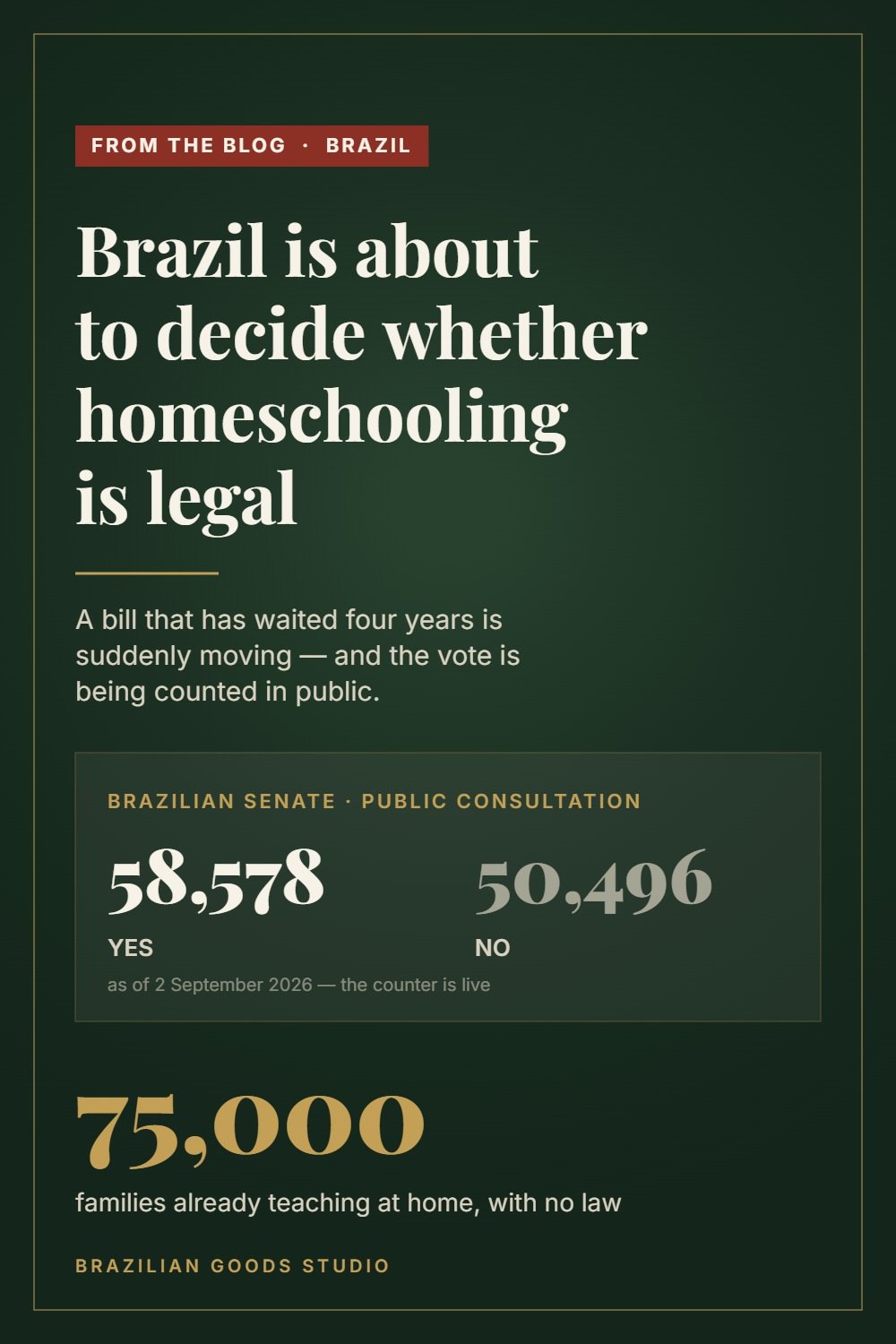
As of 4:54 p.m. on 2 September 2026, 58,578 Brazilians had voted yes and 50,496 had voted no on a bill that would make homeschooling legal in Brazil for the first time. The vote is a public consultation on the Federal Senate’s own website, it is open right now, and the counter updates live. That is the closest thing this country has ever had to a national referendum on the question, and almost nobody outside Brazil knows it is happening.
I am writing this from Rio de Janeiro. I have four people in this house and I make school material for a living, so this is not an abstract news story to me. But I also know how strange the Brazilian situation looks from a kitchen table in Ohio, where the question “is homeschooling legal?” has an obvious answer. So let me lay out what is actually on the table, what the bill would require, and why the next five weeks decide it.
The short version
Homeschooling in Brazil is not illegal in the way people assume. It is unregulated — which, in practice, is worse. There is no federal law authorizing it, and the Supreme Court has ruled that without such a law, a family has no enforceable right to teach their own children at home. So a Brazilian family that homeschools is not breaking a homeschooling law. They are failing to enroll a child in school, which is a separate offense, and that is what prosecutors charge.
Bill 1338/2022 would change that. It has already passed the Chamber of Deputies. It is now sitting in the Senate, where it spent four quiet years — until this July, when senators filed an urgency request to skip the committee queue and take it straight to the floor.
What the bill would actually require
This is the part that surprises American homeschoolers in both directions. The Brazilian bill is stricter than most US states in one way and looser in another.
- At least one parent or guardian must hold a university degree. There is no equivalent requirement in any US state.
- But the teaching parent does not have to be a licensed teacher. That was the sticking point in earlier drafts and it did not survive.
- The family has to register with the school system, follow the national curriculum base, and submit the child for annual evaluation.
- It amends two existing laws at once — the education framework law of 1996 and the Child and Adolescent Statute of 1990. That second one matters, because it is the statute prosecutors currently use against homeschooling families.
The degree requirement is the line that would decide how many families qualify. Brazil’s homeschool association estimates roughly 75,000 families and more than 150,000 students are already educating at home. Nobody has published how many of those households contain a university graduate.
How the bill compares to a US state
If you homeschool in a low-regulation US state, Brazil’s proposal will look heavy. If you homeschool in New York or Pennsylvania, it will look familiar — with one exception that has no American equivalent at all.
- Notification: familiar. Plenty of US states require you to register with a district or state authority.
- Curriculum standards: familiar. Several states require instruction in specified subjects.
- Annual evaluation: familiar. Standardized testing or portfolio review is standard in the higher-regulation states.
- A university degree for the teaching parent: not familiar. No US state requires this.
That last line is the whole political fight compressed into one clause. Supporters call it the safeguard that makes the bill passable. Critics on the homeschool side call it a filter that legalizes home education for the middle class and leaves everyone else exactly where they are — technically able to homeschool, legally unable to.
Eight years ago this month, the Supreme Court said no
On 12 September 2018, Brazil’s Supreme Federal Court decided RE 888.815 and fixed the binding thesis for the whole country: there is no public subjective right of a student or family to home education, because it does not exist in Brazilian law.
Read that carefully, because it is routinely misquoted in English. The Court did not say homeschooling is unconstitutional. The majority opinion, written by Justice Alexandre de Moraes, held the opposite — that the Constitution contains no absolute ban. What the Court said is that homeschooling requires a law, and Brazil does not have one. It handed the question to Congress, and Congress sat on it.
That was eight years ago this month. Bill 1338/2022 is Congress finally answering.
Why this got urgent: the conviction
The reason the bill is moving now is not abstract. Brazilian courts have started convicting parents. I wrote about one of those cases here: a couple convicted for teaching their own daughters. That case is what turned homeschooling from a policy debate into a story with names in it, and stories with names in them are what move legislatures.
The public consultation, and why both sides are fighting over it
Brazil’s Senate runs a permanent public consultation portal called e-Cidadania. Every bill in the Senate gets a yes/no poll open to any citizen. It is not binding. It is, however, extremely visible — senators cite the numbers in floor speeches, and journalists screenshot the counter.
Which is why teachers’ unions have been running organized campaigns telling members to go vote no. The yes side leads by roughly eight thousand votes out of about 109,000 cast, which in a mobilization contest is not a comfortable margin. If you check the counter after reading this, the number will have moved.
The deadline nobody is talking about
Brazil votes in a general election on 4 October 2026. In the weeks before a Brazilian general election, Congress empties out — members go home to campaign, committees stop meeting, and controversial bills stop moving. Government websites are also under legal restrictions on publishing during the electoral period, which is why several federal sources are partly offline right now.
So there is a real window, and it is about five weeks wide. Either the Senate takes the bill to the floor before the election, or the whole thing waits for a new Congress in 2027 — with a different Education Committee, different chairs, and no guarantee the urgency request survives.
What this looks like from the United States
American homeschooling is at roughly 6% of school-age children — about double the pre-pandemic share — and it grew another 4.9% in the 2024-25 school year, more than twice its pre-pandemic growth rate. It is, by a wide margin, the fastest-growing education model in the country. The argument in the US has moved on to regulation, oversight and testing.
Brazil is eight years behind that conversation, and about 75,000 families are living in the gap. If you have ever wondered what the American homeschool movement would look like without the legal ground it won in the 1980s and 90s, Brazil is the answer, running live, this month.
What happens next, either way
This part is my reading, not reporting, and I will label it as such.
If it passes: Brazil goes overnight from having no homeschooling law to having one of the more prescriptive ones in the Americas. The 75,000 families stop being defendants and start being registrants — the ones who qualify. Expect a second fight almost immediately over the degree requirement, and expect it in the courts rather than in Congress.
If it stalls: the 2018 Supreme Court thesis stays the operative law, which means prosecutors keep the tool they have been using. Families keep homeschooling — they have been doing it without a law for years — and the cases keep arriving one at a time, decided by whichever judge draws them. That is the status quo, and the status quo is what produced the conviction I wrote about.
Either outcome is a bigger story than its coverage in English suggests. A country of 200 million people is deciding, for the first time, whether a family may teach its own children — and the deciding vote is being counted in public, on a government website, this week.
Where to check it yourself
I would rather you not take my word for any of this. The Senate consultation, with the live counter, is on the Senate’s own site. It is in Portuguese; your browser will translate it, and the two numbers under SIM and NÃO need no translation.
One honest caveat about the numbers in this article: the vote count is a single official source, a live counter, and it is accurate to the timestamp above and nothing more. Everything else here — the Supreme Court date and thesis, the bill’s status, the degree requirement, the 75,000 estimate, the US figures — I checked in two independent sources before publishing.
If you teach Brazil at home
This studio is four people in Rio de Janeiro making printable school material about our own country, which is a slightly absurd thing to do from a place where homeschooling has no legal status. We do it because the demand is almost entirely American, and because the Brazil in most US curricula is a rainforest, a carnival photo and a soccer ball.
Our Brazil Unit Study is the full version — geography, history, food, language, the Amazon, the cities, with the maps and worksheets. It is available as a printable download in our Etsy shop and as a paperback on Amazon. Written here, checked here.
I will update this post when the Senate moves, in either direction.
As an Amazon Associate I earn from qualifying purchases.