
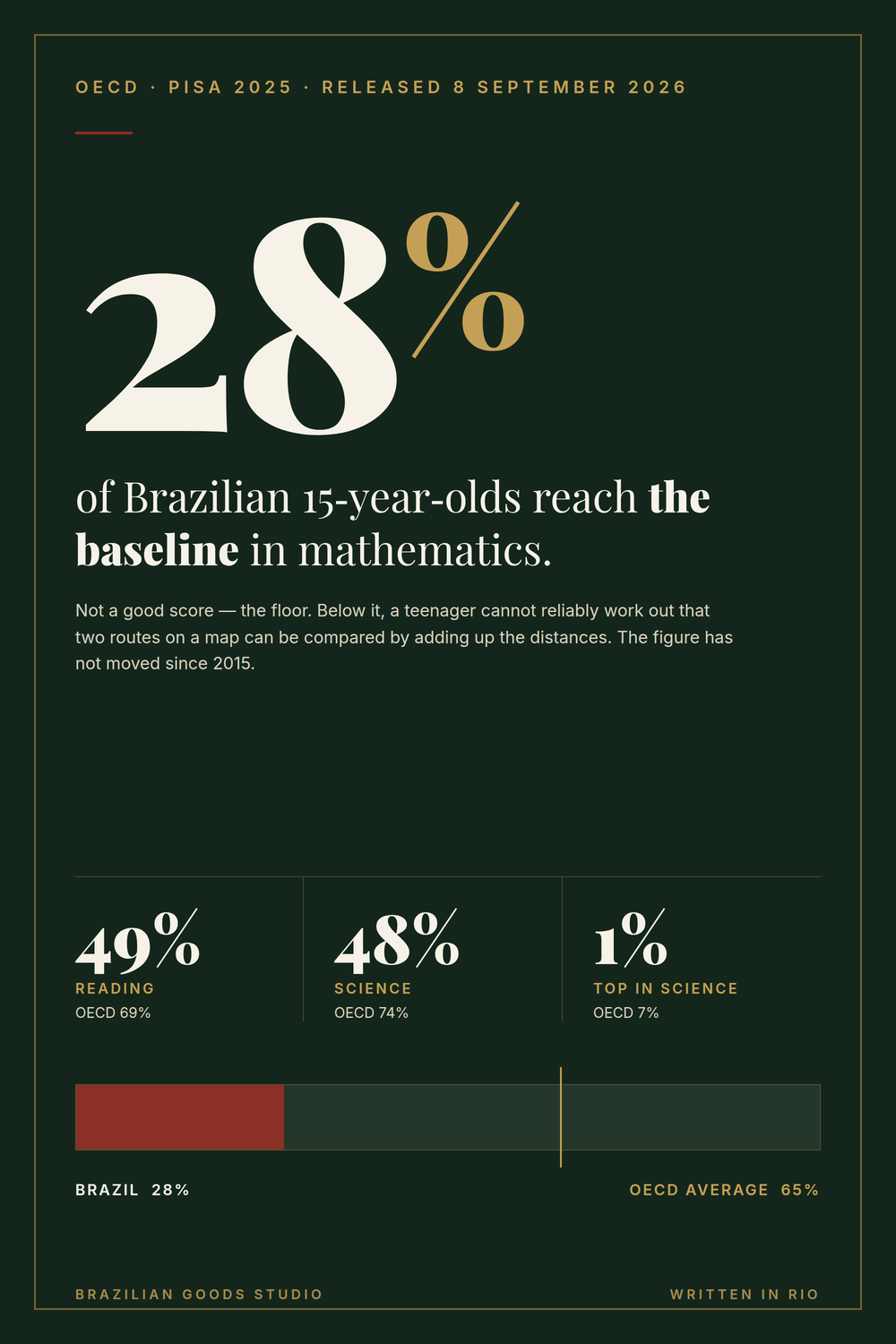
The number, up front. In the PISA 2025 round released on 8 September 2026, 28% of Brazilian 15-year-olds reached the baseline level in mathematics. The OECD average is 65%. That means roughly seven in ten Brazilian teenagers cannot reliably compare two routes on a map or convert a price into another currency. The figure has not moved in ten years.
Written in Rio de Janeiro by Luciano Moreira. Every figure below is taken from the OECD’s own country note for Brazil, published 8 September 2026, and cross-checked against Brazilian coverage. Links to both are at the end.
In August I wrote here about a couple in the interior of São Paulo who were convicted for teaching their own daughters at home, and I used a line about three in four Brazilian students failing to reach the basics in maths. That line came from the previous PISA round. A fair reader could have said: those numbers are old, wait for the new ones.
The new ones arrived on 8 September. They did not soften the picture. They extended it by a decade.
What the OECD actually published
PISA tests 15-year-olds in science, mathematics and reading. Brazil has taken part since 2000. This round covered 91 countries and economies; Brazil’s sample was 30,140 students. Here is where the country landed.
| Subject | Brazil, mean score | OECD average | Students reaching the baseline (Level 2) | OECD average at baseline |
|---|---|---|---|---|
| Mathematics | 377 | 469 | 28% | 65% |
| Reading | 408 | 466 | 49% | 69% |
| Science | 409 | 486 | 48% | 74% |
Level 2 is not a good score. It is the floor: the point at which a student can identify the main idea of a text of moderate length, or work out, without being told how, that two routes on a map can be compared by adding up distances. Below it, a teenager is not a weak student. They are a student the school system did not reach.
At the other end, the OECD counts “top performers” as students at Level 5 or 6. In Brazil that is 1% in science, 1% in reading, and, in the OECD’s own phrasing, “almost no students” in mathematics. The OECD average is 7%, 6% and 8%. In B-S-J-Z (China), 54% of students reach that level in maths.
The headline said Brazil is closing the gap. The country note says otherwise
Brazil’s public broadcaster ran the result under a headline about the country moving closer to wealthy nations. That is defensible arithmetic: the distance to the OECD average in mathematics has narrowed from 131 points in 2006 to 92 points today. On paper, the gap shrank.
But the OECD country note is blunt about where that movement came from, and it was not from Brazilian classrooms getting better:
“Average 2025 results in Brazil were about the same as in 2022 in mathematics, reading and science. This stability of results extends, in fact, for over a decade: in all three subjects, PISA 2025 results were close to the level observed in all assessments since 2015.”
OECD, PISA 2025 Results (Volume I) — Country Note: Brazil
Ten years, three subjects, no movement. A gap that narrows while you stand still is not progress. It is the other runners slowing down — and much of the OECD did slow down after 2020. Reporting that as Brazil catching up is how a country talks itself out of an emergency.
The same note records that in mathematics the distance between Brazil’s strongest 10% and weakest 10% widened between 2022 and 2025.
The gap inside Brazil is getting wider, not narrower
This is the part that gets almost no coverage here, and it is the part that decides what a Brazilian childhood actually looks like.
- 35% of Brazilian students sit in the bottom quarter of the international socio-economic scale — the largest single share of the four. Their average science score was 380.
- Inside Brazil, the most advantaged quarter outscored the least advantaged quarter by 96 points in science. Across the OECD the same gap averages 85.
- Between 2015 and 2025 that gap widened in Brazil while it narrowed across the OECD. Performance improved among advantaged students and stayed flat among disadvantaged ones.
- Socio-economic status explained 16% of the variation in science results here, against 12% on average across the OECD.
Read those four lines together and you get the sentence nobody wants to print: over the past decade, Brazilian schooling got better at serving the children who were already fine.
The children are not the problem
It would be convenient to blame the students. The questionnaire data makes that hard.
72% of Brazilian 15-year-olds say they are curious about many different things — the OECD average is 73%. 59% say they put in extra effort when work gets hard, against an OECD average of 60%. And the share who agree that school has been a waste of time is 16% in Brazil against 24% across the OECD — a figure that fell by nearly seven percentage points since 2022.
So: Brazilian teenagers are as curious as their peers anywhere, work as hard, and think better of their schools than the OECD average does. They show up believing in the place. The place returns 28% in maths.
What this has to do with teaching your own children
Here is why a homeschooling family in Ohio should care about a Brazilian statistic.
In the United States, a parent who looks at a set of results like this has an exit. It may be a hard exit, it may cost a salary, but it exists in all fifty states. In Brazil it does not. Home education here is not banned by name — the Supreme Federal Court ruled in 2018 that it does not violate the Constitution. What is missing is a law regulating it, and without one, prosecutors charge parents under a 1940 statute for failing to enrol a child. Bill 1338/2022 would change that, and it has been sitting in the Senate since passing the lower house.
That is the whole argument in one image. A country publishes a result that says seven in ten of its teenagers missed the floor in mathematics, and the families who read that result and want to do something about it are the ones with a criminal file open.
Whatever you think of home education, a system that performs like this and forbids the alternative is not defending a standard. It is defending a monopoly.
What we do in this house
We teach our two boys in English and live in Portuguese, and we build the material ourselves because the material we wanted did not exist — least of all material that treats Brazil as a place worth studying rather than a holiday backdrop. That is the whole of what this studio makes.
If you want the country itself as a subject rather than a footnote, the Brazil Unit Study is where most families start, and the full catalogue lives in our Etsy shop. Written at a kitchen table in Rio, by the four of us, for the price of a takeaway.
Sources
- OECD, PISA 2025 Results (Volume I) — Country Note: Brazil, published 8 September 2026. All proficiency shares, socio-economic figures and questionnaire percentages above are taken from this document.
- Agência Brasil, “PISA: Brazil moves closer to wealthy countries in school performance”, 8 September 2026, for the mean scores and the 2006–2025 gap comparison.
- Supremo Tribunal Federal, Recurso Extraordinário 888.815 (12 September 2018), on home education and the Constitution.