
On 4 August 2026, Holafly published a Travel Dupe Index and the internet did what the internet does with a good list: it shared it everywhere. Ten pairs, each one a famous, overrun destination matched with a quieter place that delivers the same thing for less. Ghent instead of Venice. Cascais instead of Saint-Tropez. Jeonju instead of Kyoto. Ciudad Perdida instead of Machu Picchu. The headline number was up to 83% off accommodation, depending on the swap.
It is a genuinely useful idea. And Brazil is not in it. Not one entry. A country with 4,600 miles of coastline, a colonial town the sea cleans by itself, a desert that fills with freshwater lagoons every winter, and canyons that would be a national park with a shuttle bus and a gift shop anywhere else, and it did not make a single line of the sheet.
So here is the page they did not write. Six Brazilian dupes, each one matched to the crowded place people are actually trying to get away from, with the thing that makes it different rather than just cheaper. I live in Rio. I have been to all of them, and I will tell you where each one is genuinely worse, because a dupe list that only lists upsides is a brochure.
What makes a dupe honest
Most dupe lists match photographs. That is why they disappoint. You arrive, the light is different, the food is different, and the thing you actually wanted is not there.
A dupe only works if it replaces the reason, not the postcard. Nobody wants Positano because of the specific colour of the houses. They want a small old town where the water starts where the street ends and dinner takes three hours. Nobody wants Tulum for Tulum. They want a beach where the day has a shape to it and nobody is in a hurry.
Each pair below is matched on the reason. Then I tell you what is different, because the difference is usually the best part.
1. Paraty instead of Positano
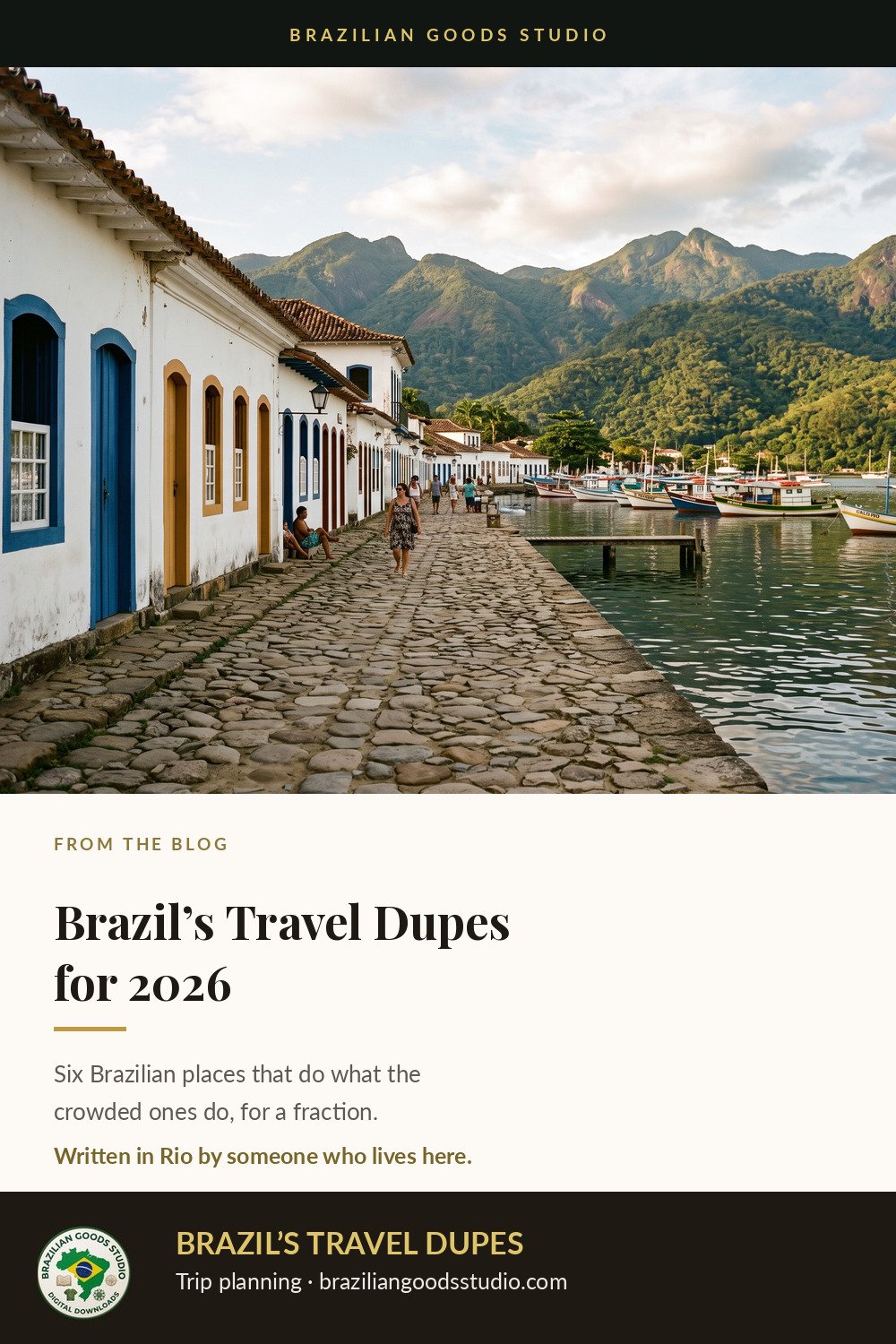
The match. A small colonial town on the water, whitewashed houses with painted window frames, wooden boats moored where the last street ends, and a green mountain standing directly behind the roofs. Cars are kept out of the historic centre. You walk on stones and you eat slowly.
The difference. Paraty’s streets were built to flood. The Portuguese laid the paving so that a spring tide runs into the historic centre through gaps at the shoreline, washes the streets, and walks back out with the dirt when it turns. Nobody hoses those stones. The sea does it, twice a month, for free, and has been doing it since the eighteenth century. Visitors panic the first time they see water coming up the cobbles. It is supposed to do that.
Where it is worse. The stones. They are large, rounded, uneven and slick when wet, and they are not friendly to a suitcase with wheels, a stroller, or an ankle you already had an opinion about. Bring shoes with grip and pack something you can carry.
Getting there. Four to five hours by road from Rio along the coast, which is one of the best drives in the country. There is no airport worth using.
2. Jericoacoara instead of Tulum
The match. A small beach village that runs on its own rhythm, no traffic in the centre, dune-and-lagoon landscape, and a sunset that the whole village walks to at the same hour, every evening, like a service.
The difference. There is no asphalt. The streets are sand, and that is not a charming accident, it is the rule. The village sits inside a national park declared in 2002, and the paved road stops well short of it: the last stretch is sand, and almost everybody comes in by four-wheel drive or on the local bus that is built for it. Every inconvenience in Jericoacoara is doing a job. The difficulty of getting there is exactly what has kept it from becoming the thing it replaces.
Where it is worse. Getting there is a project. You fly to Fortaleza or Jericoacoara’s small regional airport, then transfer, then transfer again onto sand. Budget two half-days of your trip to arrive and to leave, and do not schedule a tight international connection on the way out.
When to go. The wind that makes it a world kitesurfing address blows hardest from July to December. If you want water sports, that is your window. If you want stillness, it is not.
3. Chapada Diamantina instead of Zion
The match. Flat-topped mountains, canyons you look down into rather than up at, day hikes that end standing in cold water, and small towns at the trailheads that exist because of the park.
The difference. It was a diamond district first and a park second. The trails across the plateau were cut in the nineteenth century by prospectors hauling supplies to the diggings, and the long routes still follow them. You are not walking a park route that a planner drew. You are walking somebody’s commute, and the ruined stone walls beside the path are the reason it exists.
Where it is worse. There is no shuttle, no ranger station handing you a map, and very little signage. Guides are not a luxury here, they are the infrastructure, and you should hire one for anything longer than a half day.
When to go. Dry season, roughly May to October, is the walking season. In the wet months the waterfalls are spectacular and the trails are mud.
4. Lençóis Maranhenses instead of a desert
The match. White dunes to the horizon, the light doing impossible things at both ends of the day, and the specific silence people fly to deserts for.
The difference. It rains here, and that is the whole point. The rainy season runs roughly January to May, and the water gathers between the dunes in thousands of freshwater lagoons that sit there for months instead of draining away. So you get a desert you can swim in. It is not a metaphor and it is not a single photogenic pool: it is a field of them, warm, clear, and moving position from one year to the next.
When to go, and this one is not negotiable. June to September. That is when the lagoons still hold last season’s water and the heavy rain has stopped. Come in November and you will get beautiful, entirely dry sand and wonder what everyone was talking about. This is the most date-sensitive destination in Brazil, and it is the one people most often get wrong.
Where it is worse. Remote, hot, and there is nothing to do in the evening. Two or three nights is the right dose.
5. Ilha Grande instead of the Thai islands
The match. A green island with more beaches than roads, boats as the only way between them, forest running down to the sand, and no obligation to be anywhere.
The difference. There are no cars. Not “few cars” or “cars discouraged” — the island is car-free, and everything moves on foot or by boat. That single fact changes the noise, the smell and the pace of a place more than any amount of design ever will. And the island is close: a couple of hours from Rio to the pier, then a short crossing.
Where it is worse. No cars also means no taxi when it rains and your bag is heavy, and the trails between beaches are genuine hikes, not strolls. And you are still in the Atlantic Forest, so bring repellent you actually trust.
6. Serra Gaúcha instead of Tuscany
The match. Hills covered in vines, family wineries you can walk between, cool evenings, long lunches, and towns built by Italian immigrants who brought the food with them and never stopped making it.
The difference. Vale dos Vinhedos, spread across Bento Gonçalves, Garibaldi and Monte Belo do Sul, became Brazil’s first wine Denominação de Origem in 2012. It is a small, tightly defined area of about 72 square kilometres, which means you can do it slowly and on foot in a way that is impossible in a region ten times the size. And Brazilian sparkling wine from these hills is the country’s most under-recognised export. Order it. It is the thing they are actually best at.
Where it is worse. It is cold in winter, in a country most people visit for heat, and Gramado in December is its own kind of crowded. Come in the shoulder months.
The six pairs, in one table
| Instead of | Go to | Best months |
|---|---|---|
| Positano, Italy | Paraty, Rio de Janeiro | April to October |
| Tulum, Mexico | Jericoacoara, Ceará | July to December for wind |
| Zion, Utah | Chapada Diamantina, Bahia | May to October |
| A desert | Lençóis Maranhenses, Maranhão | June to September only |
| The Thai islands | Ilha Grande, Rio de Janeiro | April to June, September to November |
| Tuscany, Italy | Serra Gaúcha, Rio Grande do Sul | March to May, September to November |
The catch nobody puts in a dupe list
A dupe index compares the price of a bed. That is the honest limit of the format, and it is why these lists sometimes send people somewhere that turns out to cost more overall.
- Brazil is enormous. Paraty and Jericoacoara are nearly 1,900 miles apart by road. You cannot chain these six the way you would chain six European towns. Two per trip is realistic, three if you are willing to spend real money on internal flights.
- Internal flights are the budget line that surprises people. They are not the cheap part of a Brazilian trip, and booking them late is expensive in a way that can erase the accommodation savings entirely.
- Americans need a visa. The Brazilian e-visa requirement returned in April 2025. It is fully online and it is not difficult, but airlines validate the code before they issue a boarding pass, so it is not something to leave for the airport.
- Low season is a real discount, not a marketing one. The gap between a February bed and a May bed in Brazil is larger than the gap between most of these dupes and their originals.
We keep the full breakdown of what a trip actually costs, by budget level and by month, in How Much Does a Trip to Brazil Really Cost in 2026?, and the month-by-month timing for each region in The Best Time to Go to Brazil. If you are pairing one of these with the city, Rio, 10 Years After the Olympics covers what in Rio is still standing and what is not.
How I would actually sequence them
If you have ten days and one flight into Rio: Rio, then Ilha Grande, then Paraty, all by road and boat along the same coast. That is the whole Positano-and-Thai-island end of this list in one loop, with no internal flights at all. It is the cheapest good trip in Brazil and almost nobody structures it this way.
If you have two weeks and you want the landscape: Salvador, then Chapada Diamantina, then north to Lençóis Maranhenses if your dates land in the June-to-September window. If they do not, swap Lençóis for more days in the Chapada rather than going anyway.
If you are going for wine and cool weather: Serra Gaúcha on its own, four nights, flying into Porto Alegre. It does not pair well with anything else on this list and it does not need to.
Why Brazil keeps missing these lists
Partly language. Most of what has been written about these six places is in Portuguese, and the dupe lists are assembled in English from English sources. Partly distance, because a list aimed at European travellers is not going to put a ten-hour flight next to a train to Ghent.
But mostly it is that nobody has bothered. The comparison is right there. A colonial waterfront town, a car-free island, a dune field with water in it, a canyon system with nineteenth-century trails, and a wine region with a legally defined origin, all in one country, and the index that was supposed to find exactly this kind of place looked past all of it.
Everybody is in Portugal this year. Somebody has to hold it down on the other side of the ocean.
The Kit That Works in All Six Places
The six dupes on this list span beach, jungle, colonial town and highland. One kit covers all of them.
- Lonely Planet Brazil — One book that actually covers the places the dupe lists skipped.
- TESSAN Brazil plug adapter, 2-pack — Two, because one always ends up in the wrong bag.
- G4Free packable daypack — Folds into a pocket, opens into a day bag when you leave the big luggage behind.
- Blue Lizard Sensitive Mineral SPF 50 — Reef-friendly, which matters on half of these coastlines.
- ANYOO hooded rain poncho — The tropical version of rain arrives in ten minutes and leaves in twenty.
Everything here fits in the same corner of a carry-on and works whichever of the six you pick.
Brazilian Goods Studio is a participant in the Amazon Services LLC Associates Program. As an Amazon Associate we earn from qualifying purchases, at no extra cost to you. Check current price on Amazon.